Loofah gourds coming on
You may recall that I posted about the sudden appearance of gourds a couple of weeks ago. I had clusters of male flowers for weeks but no female ones until the first week of August. The bumblebees did a bang up job making sure there was plenty of pollination and bingo, I finally had gourds on the vine.
Just add water and these things take off. The vines are so big that the dry conditions caused them to wilt severely while I was stuck in Florida last week. Some good slow soakings of the hill/bed perked them up again and since then the gourds started getting some size to them.
They really look like giant hanging zucchini:

This is the one I posted earlier when it really was the size of a small zucchini; since then it has grown at least 5x.

Now that these are larger I see that there are substantially more on the vines that I thought earlier; it looks like I’ll have a decent haul in a few weeks when they start browning and drying.
Why would I grow these? I don’t know really.
Why not?
😉
Once they dry, the skin peels right off and after the seeds are shaken out you are left with the fibrous skeletal frame that is the “sponge” we’ve all seen.
I’ll share- I don’t know what I would do with one or two much less a few dozen.
Ancho, Ancho Man
Ancho, Ancho Man
I want to be
an ancho man
Sorry. “Poblano” is tough to work into a corny title so the “Macho Man” chorus it was…..
Anyway, this post is actually about poblano peppers, the mild green chile used in chile rellenos. Once a poblano is dried, it turns a dark red and is then referred to as an “ancho” pepper.
This year I got 0% germination from my poblano seeds and ended up picking up a single plant from the Home Depot garden center (Bonnie nurseries supplies the stores in my area).
The plant is over 5 feet tall now and as of this morning had about two dozen peppers on it. I have read that the time to harvest poblanos is when the green turns really dark with a black hue to it, like the one on the right:

So I harvested a few, along with yet another pile of jalapenos:


I haven’t decided whether to roast and freeze these or consume them over the next week, or perhaps string them up to dry in to anchos.

(After being stuck in south Florida on business for a week, a weak pepper picture post is all I can muster. )
Irene
100 mile view of Hurricane Irene, 6:00 PM, from my hotel balcony in Ft Lauderdale.

Strawberry prep for next spring
Strawberry beds start slowly, hit peak production and then decline fairly quickly over a few seasons.
The slow start comes when beds are planted in the spring- a few berries are produced but it is recommended to pinch off most blossoms so more energy goes towards getting the plants established for the next year.
The 2nd and 3rd years’ production is high as the plants produce and send out runners creating more plants.
From here, the bed chokes itself out and production is limited due to competition and disease issues brought on by the overpopulated bed.
This is a somewhat simplified explanation but pretty much sums up how it works….
So what to do?
Thin the established beds.
Why?
First, the remaining plants do much better.
Second, you can easily replant the pulled runner plants in new beds in late summer/fall to start the cycle over.
Third, and most important to cheap arsed er… I mean “frugal” gardeners, is you get new plants for free. In the spring strawberry plants can run a couple bucks each. My original plants were “only” about a dollar a piece, a very good deal at the time, but that was still $50. Ouch.
So that’s what I got done last week – two new strawberry beds with about 40 new transplants in them. I have time (and plenty of runners yet to thin in the original bed) to set up another bed or two.
Anyway, the new beds, back in the empty side of the boxwood garden next to the cucumber bed and trellis:
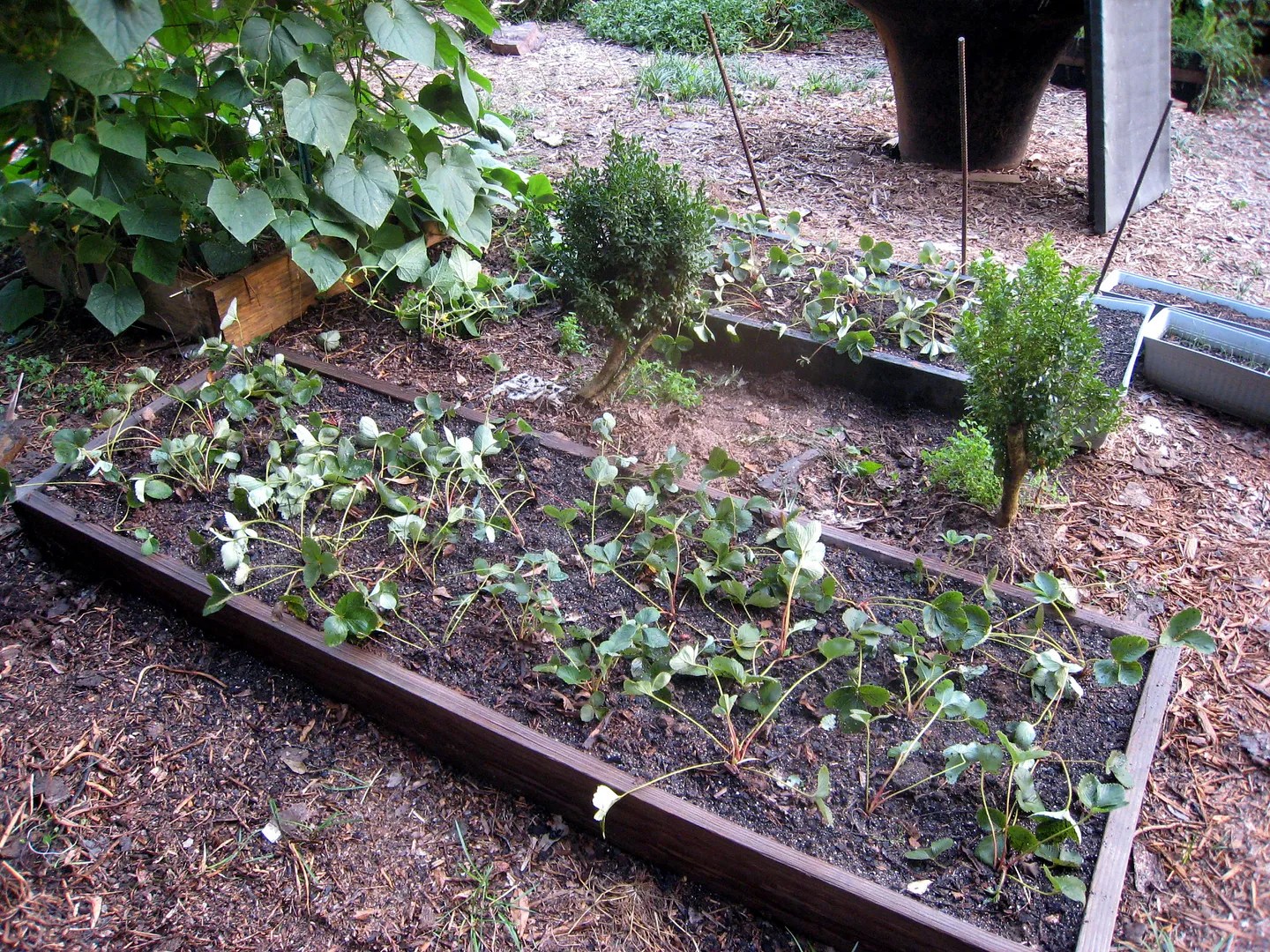

Note: The rebar is leaning over the beds to support the two shade panels you can see against the bell. relief from the late afternoon sun seems to help. Also the two american boxwoods between the beds are going to be relocated this winter.
Chillin with the cicada killers….
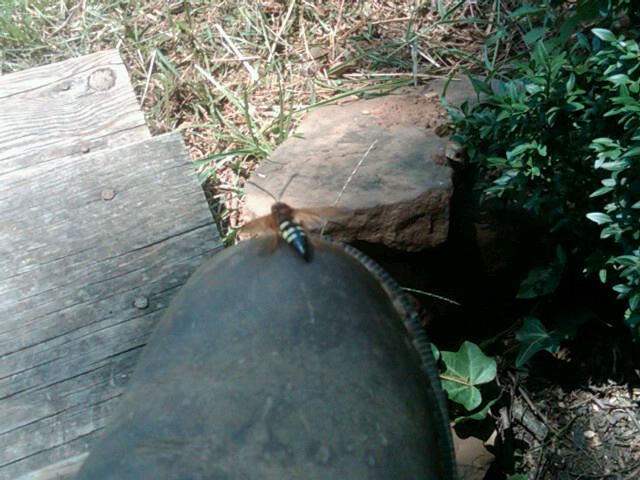
I took a break and sat really still on Lizzie’s steps in the middle of one of my cicada killer colonies.
The next thing I know, they are using me as a patrol perch: boot, knee, Blackberry, hat.
I don’t think I’ve ever bonded with bugs before. 😉
Oompa Loofah
I was getting a little disappointed in the lack of any set fruit on the loofah gourd vines. Hundreds of feet of vine sprawling everywhere have been covered up with male blooms, but no fruit blossoms:
Front side of the fence:

Back side of the fence:

A couple of days ago I checked again and finally spotted a tiny fruit:

And another slightly more developed one:

Then more like this one, about the size of a zucchini ready for harvest:

I checked out the back and it has plenty of zucchini sized ones suspended about.
So what the deal with these?
They a member of the gourd family, cousin to squash, and are edible when very small but get bitter as they grow (I haven’t tried one).
As they grow larger the inside grows a skeletal web that dries stiff. At this point, the outside skin is scrubbed or pressure washed off and you are left with a loofah “sponge”.

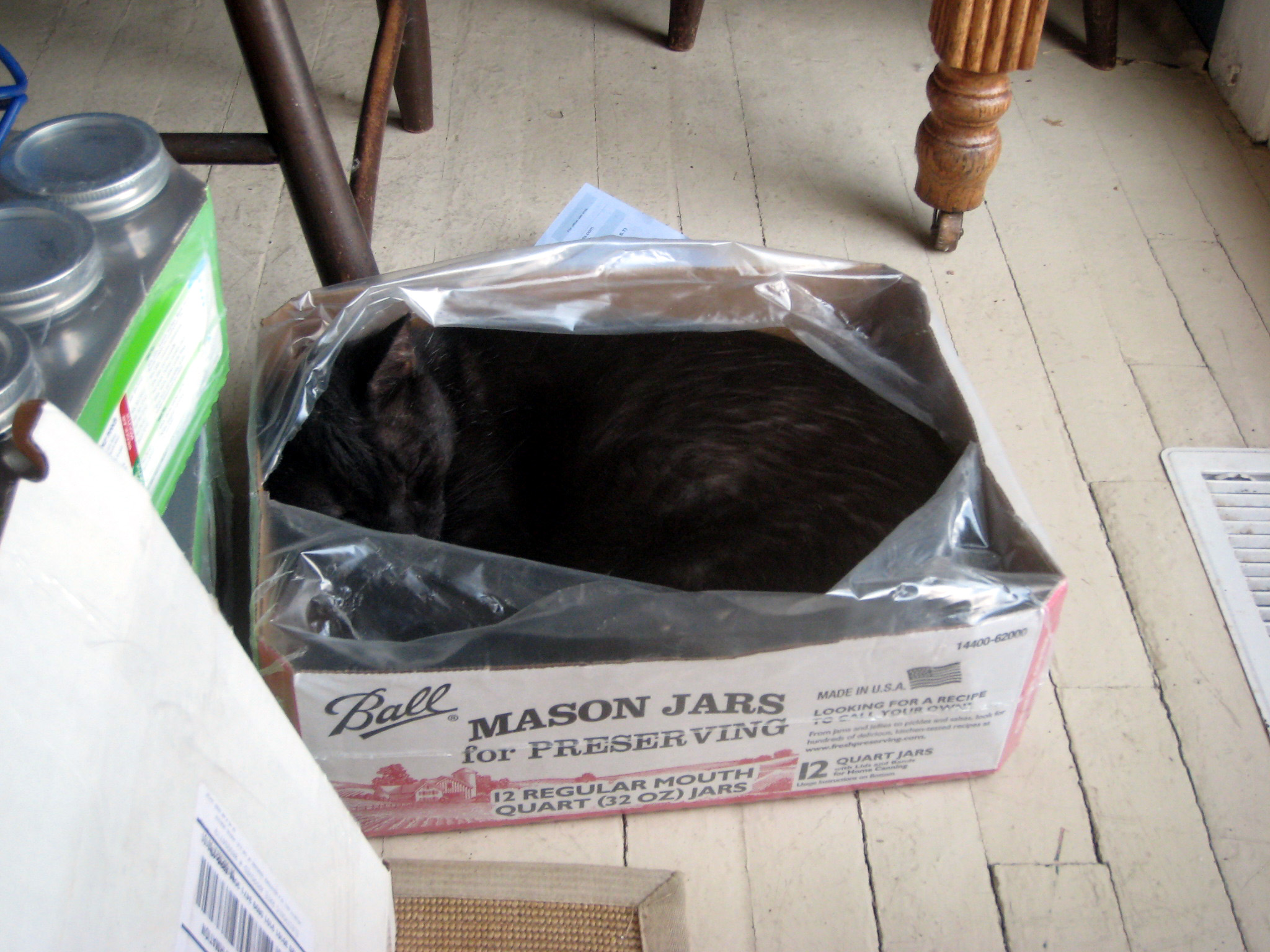
This package hast been tampered with…
The seal is broken

Paste!
The weekend’s tomato paste batch turned out to be pretty good.
We opted to freeze it in ice trays so portions could be controlled incrementally as we use it. In the end we had around 100 of these- our best guess is each is about 1/3 of one of the small cans.

Cicada killers working hard
(Bug/nature nerd post warning)
Last year I posted a couple of times about the cicada killer wasps around my house, here and again here.
This year “my” colony has come back strong and the larger females are working out of their solitary burrows in almost every area of my back and side yard.
Funny things, they are all bark and no bite when it comes to people and will aggressively buzz in front of you as you approach their home base. But they can be ignored;they are always bluffing and don’t sting people.
Anyway, the point of this post.
Sunday it was breezy and I noticed what looked like a drunk hummingbird heading towards me in a slow and wobbly flight. She was about 40 feet out when I spotted it and as it got closer I confirmed it was a cicada killer with a much larger cicada paralyzed & under its “fuselage”.
It was losing altitude fast and soon it crash landed in the grass well short of the main colony area. As I watched she dragged her much larger prey across grass, straw & dirt to the foundation of Lizzie’s house. Then she started climbing- up the foundation and siding until she reached the roof. She was using wings and legs- buzzing and walking up at the same time, but her back legs aren’t used since they are gripping the cicada. She kept going a little further up then took off again, loosing altitude and she circled around the front towards her burrow.
Apparently the standard operating procedure for these critters is to pluck cicadas from the taller and closer trees because the payload runs a little heavy for sustained flight (in other words they become slightly underpowered “gliders”.) This one was climbing to gain the altitude, in order to relaunch and transport the prey the rest of the way to the burrow; there were no trees nearby so Lizzie’s had to suffice.
She cleared the sill:

In no time she was halfway up:

And a closeup before she got out of range- this one is probably 1 1/4 – 1 1/2 inches long and the cicada is considerably larger. Check out her the little “hands” grabbing the contours while the wings are buzzing away:
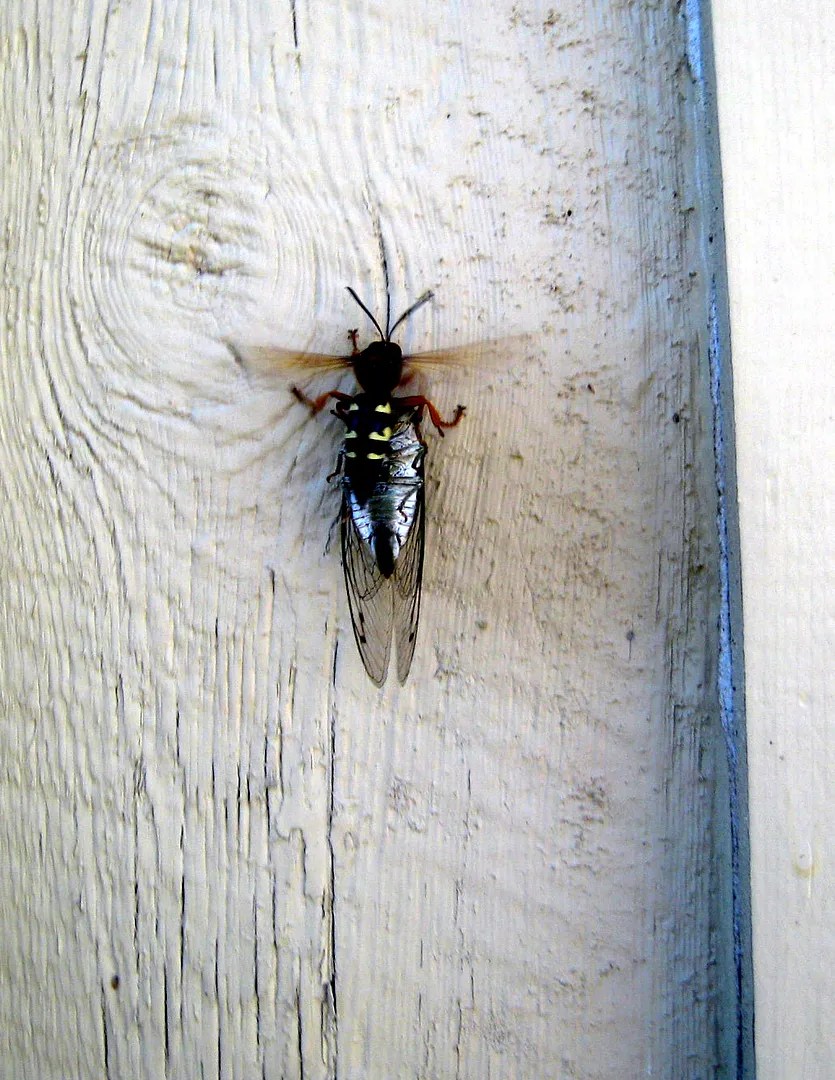
(Amazingly, mrs cohutt wasn’t nearly as interested in this as I was. Go figure. )

 Behind cohutt's fence