Glow pods
It is going to be @ or under 20 for the next three nights.
Hopefully 3 shop lights will provide enough insurance to protect the borderline stuff; 75 watts for the small lettuce and arugula bed, 300 watts each for the larger beds. All are directed into a water jug create a radiant mass and to even out the hot/cold spots.
No, I’m not concerned what the neighbors will think. They already think I’m nuts; however the NSA will probably be sending in the black helicopters for a closer look tonight.

With a flash for perspective:

The middle bed has no supplemental heat- it is mainly broccoli, cabbage and brussel sprouts and just the cover should be enough protection for these.
More morel
The morel mushroom grew a bit in the 24 hours after the post and pictures here


(Ahem…. I’ll go ahead and make the joke since you filthy minded blog readers are already thinking it: Is that a morel in your pocket or are you just happy to see me. There, are you satisfied? Aren’t you ashamed of yourselves?) 😉
At this point it looked pretty close to the pictures of harvested morels I had found on the web, but I left it in the ground. The wet green slime had mostly dried to a darker and slightly less disgusting color and texture.
Theoretically it has now spored out and next year I may have the opportunity to be adventurous and harvest one or two. More likely, I’ll just post another picture or two and talk about harvesting them. I’m probably not the guy to eat wild fungus from my own backyard.
(Due to cold, rain, dark and slackness there were no subsequent pictures of this; it stayed the same size and the top bleached out. Easy come easy go….) .
Winter gardening and makeshift poly tunnel construction
With a few nights into the mid 20s so far the original “pods” have done their job just fine. Everything underneath is doing quite well.
Forecasts for this week include 3 nights the upper teens here and I decided I’d cover the two other beds in the rear as well. These contain broccoli, brussel sprouts, cabbage and cauliflower, all of which are considered relatively hardy.
So why go to the trouble?
First: I don’t want to repeat last year’s broccoli disappointment, where a tiny bit of freeze damage inside several heads lead to a rotten bud or two in otherwise healthy looking heads. Believe me, it only takes one rotten bud to ruin the whole head.
Second: cauliflower I’m not sure how hardy my type is and I have heard that cauliflower in general isn’t as hardy as broccoli.
Third: I’d hate to lose the lats of my fall crop over a degree or two and I had the materials on hand.
So here is are the three back beads all tucked in waiting for the chilly nights ahead:


The one on the right was my original “covered wagon” style tunnel. The advantage of this type is there is plenty of clearance on the sides and ends; plastic touching tender plats in a freeze will cause damage. Also the higher center line allows for more volume and theoretically less chance of frying plants should i get lazy and leave them on when the sun is out and the temperature inside rises. With the high only in the 30s for the next couple of days I will eave them covered during the day.
This is what the inside of the bed looks like (the water jugs theoretically are heat sinks that might protect the lettuce and you greens in the immediate area.)

To connect the pvc hoops I used conduit brackets that are all of 10 for $1.19; I cut short sections of larger diameter pvc to act as a sleeve for the hoops, My logic was that the load might be spread a bit from the “bow” stress of the hoop plus I can remove and put up the hoops easily if I need to.

The other two beds were constructed using a quick short cut design basically because I was short on time and pvc. On both of these I used an end to end arch with one (one the 12 ft bed) or two (on the 16 ft one) hoops across the middle. As you can see the broccoli, cabbage and brussel sprouts on the southern end are doing quite well.

Seeing how my drill was at my office, I had to come up with a different anchoring plan for the arches. I used two methods.
1. Driving a piece of larger diameter pvc into the ground to so that the hoop ends can be inserted

2. Doing the same with re-bar so that the hoop can be threaded onto it

I should note I also used a third method on the small arugula and lettuce bed. I staked either end then ran twine through a pvc pipe that had been stretched over two low hoops. This is probably the dumbest method since getting a good seal on the end in more difficult but I haven’t been worried enough yet to change it.
The staked twine method:

and a shot of the whole small bed (that’s more arugula than I can eat between now and 2014)

Some items don’t need a cover, such as the turnip green bed (The bamboo rail was put up to keep me from inadvertently trampling the bed as the seeds w er germinating and I just haven’t bothered to take it down now that the greens are up.)

Additionally shallots (foreground) and garlic could care less about most Georgia winters:

More garlic, dropped into the holes where I removed large stepping stones and covered with a mix of mostly compost and with a little soil added:

Why go to all this trouble to garden in the winter?

🙂
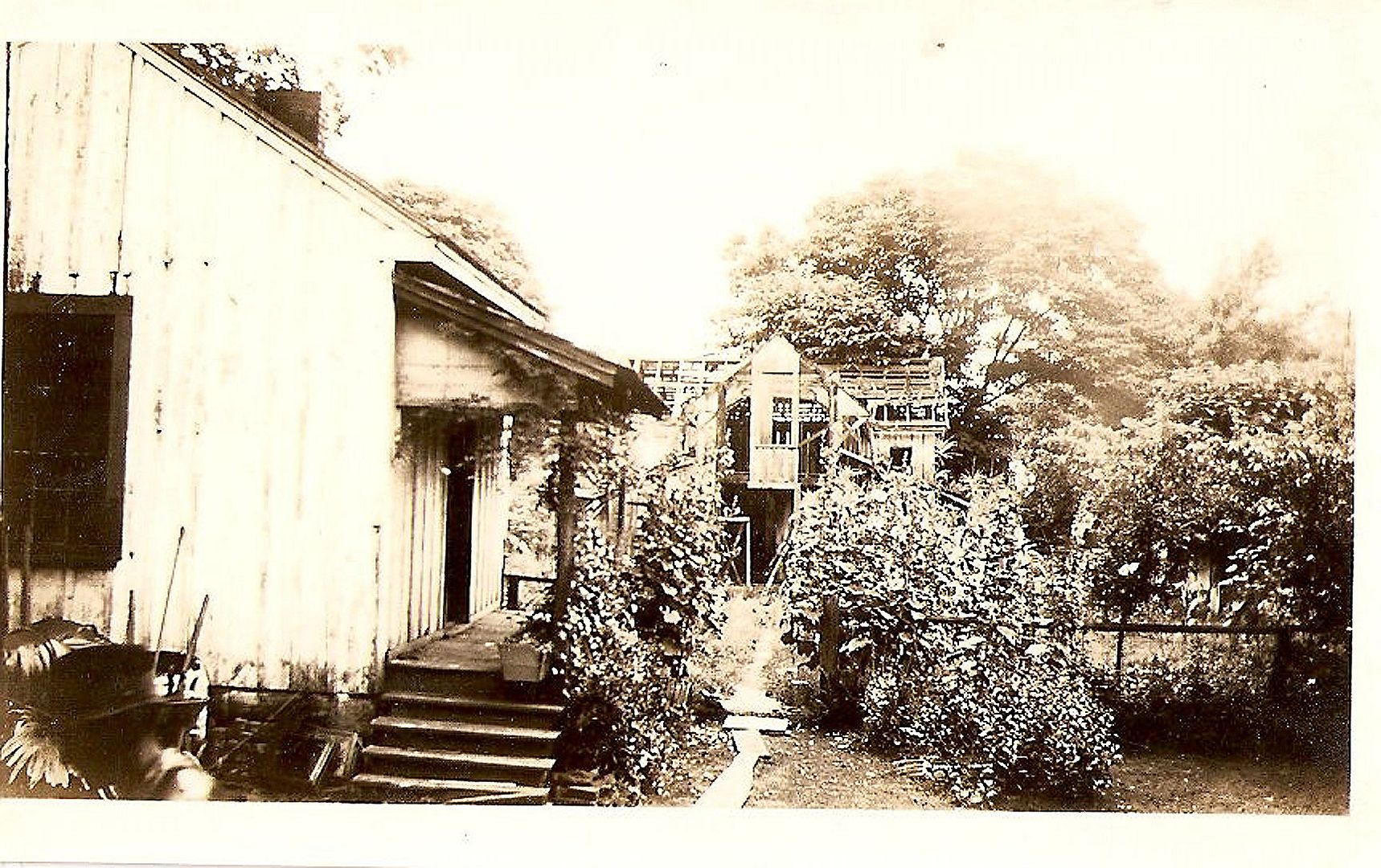
Before cohutt’s fence
Circa 1932

Slightly larger picture for detail:
The story of the morel …
Huh?
As I was surveying things in the garden today, I noticed an oddity coming up in the chewed up old spinach bed.
At first glance it looked like a white lipped fish head of some sort had been partially buried. Funny lips, a mossy green color with a light patten on it. Yeah, a garden grouper.
But was it?


It would appear that this isn’t a fish at all, in fact, it is a fungus, a ‘shroon. It looks like it is a member of the Morchellaceae family, a “true morel”, likely a “classic black morel” (even though it is looking more green than black right now).
A long time ago, the hungriest man in the world (at the time) tried eating one of these. Apparently he didn’t die and it was tasty enough to be remembered. Really? Yes, really, here is a recipe page.
Disclaimer: I am not a mycologist . If you eat this or any similar mushroom and end up pushing bile out through your nostrils, or worse, it would NOT be my fault, it would be your fault. I do not advocate eating or tasting wild mushrooms of any type based on an amateur garden blogger’s posts.
Brassica Ghosts
This evening I transplanted s few Swiss chard plants into the hoop covered bed (mid 20s coming in a couple of nights).
As I finished, I noticed that an almost perfect layer of condensation had descended on the surrounding turnips greens, broccoli, cabbage, cauliflower & brussel sprouts. As the light reflected off, it looked like an army of brassica ghosts had descended on the garden.
.
(Really, it did,)
.
(And I don’t do drugs.)
.
.
(I swear)
‘
‘
(See for yourself.)
.


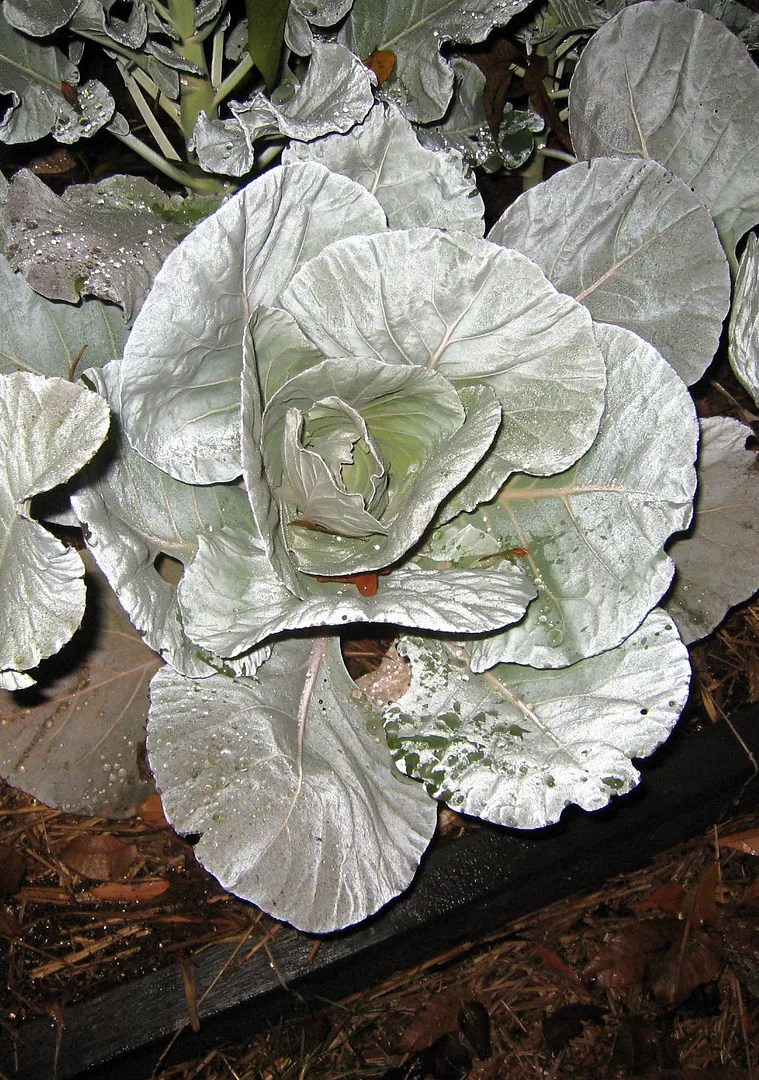
(It looks cold but it was really about 55 degrees when the pictures were taken tonight.)
More Winter Cleanup & Prep
I continued my general winter garden cleanup and preparation today (oddly, in shorts and a t-shirt as it was sunny with a high of 73).
The earlier freezes had started taking a toll on the asparagus so I decided to go ahead and cut the tops then pull the few weeds that we under the thick mass of the fronds (?). I’ll add a couple inches of compost and then maybe mulch with some chopped up leaves for the winter.
Here are a couple of pictures after I had cleared part of the bed; next year I may put up stakes in the corners and run a rope “rail” around the beds to keep the plants for falling over and spilling out of the beds.


I also vacuumed the leaves and clippings off of the back lawn with the mower, then borrowed a whole truckload of leaves that my neighbor had blown to the curb and turned a few of my tomato cages into compost bids. Or silos or tubes or something,.. I have found the loose wire compost bins to work very well; the air circulation seems to help accelerate the composting process.
I did get busted for “stealing” my neighbors leaves. Their two young girls were most concerned and to why I was talking their leaves. I talked my way out of it; the 5 year old was pretty trusting but the 3 year old needed some convincing before she concluded that it was OK for me to do that.
The bin in the corner is 4 ft tall welded wire fencing; the others are the concrete wire tomato cages with asparagus tops, bean or squash vines. I add to these as the finished compost will be maybe 1/10th the volume of the initial leaves and I’ll need a lot in the spring. (A curved section of heavier hog panel wire is in front of the cages).


Why go to all the trouble of composting, why steal neighbors leaves?
Because next year I want this again:

White trash gardening
Or so it appears


What?
Top to bottom:
1 What falls out of massive Brandywine bushes after the first freeze when you pull them off of the flower beds they were smothering.
2 The hoop tunnel with various scavenged water containers placed among the young plants. Why? Water is a decent heat sink, collecting heat during the day to disperse overnight. Ideally they are worth another degree or two of freeze protection once the cold nights are really here.
3. Taking down the gourd tower; it is laying on the bean trellis after being untethered and eased down.
4. Closer shot of the gourds that were in the top of the tower as it lies on the bean trellis.
5. The gourds in various stages of drying on Lizzie’s porch. ( Some won’t make it.)
Radishes for breakfast?
Probably not….
But:
When I ordered garlic and shallots a couple of months ago from Peaceful Valley Farm Supply aka groworganic.com, they offered a couple of free seed packs as a bonus. One of my selections was “French Breakfast Radish” .
Why?
Honestly I don’t think I’ve eaten more than a cumulative 10 radishes in my whole life, so I really don’t have an explanation. Maybe they just looked good. Yeah, and how bad could a breakfast radish be anyway? And the French are good cooks, so French radishes ……
Anyway, I planted a few squares of them and noticed recently that some were looking ready to taste.
The verdict? These are tasty little buggers- eaten raw as harvested or sliced and added to a salad. A better description can be found here at Recipetips.com
Anyway, here are a couple of them pulled this week to sample:

And yes, we are still eating fresh Brandywine tomatoes. 🙂


 Behind cohutt's fence