Epic Garden Battle: Watercress Vs. Duckweed
(“Epic”? Not really… I just wanted to use it in a title sometime….but I digress before I even begin.)
As with many experiments that occur behind the fence here, my watercress scheme was quietly fizzling offline and out of view. A post announcing it here on May 29 and a tweak posted here on July 1 had beem the extent of my reporting so far.
The shade cloth cover noted in the July follow up post certainly helped with the algae, but probably only indirectly. You see, even though the heat and transplant shock did a number on my “stolen” starter watercress plants, the modest shade allowed another interloper to thrive: Duckweed.
For those are familiar, it will come as no surprise that if conditions are right for duckweed, well, every square inch of surface will be coated in the tiny leaves. If not, a fleck or two will exist if you look hard enough, but there really is nothing in between.
This has some benefits though; an uninterrupted duckweed surface coating gains a monopoly on sunshine vs anything underneath, so the algae is choked out.
On September 25, when I decided it was cool enough to remove the shade cloth cover, this is how my duckweed, er…. I mean watercress plot looked.
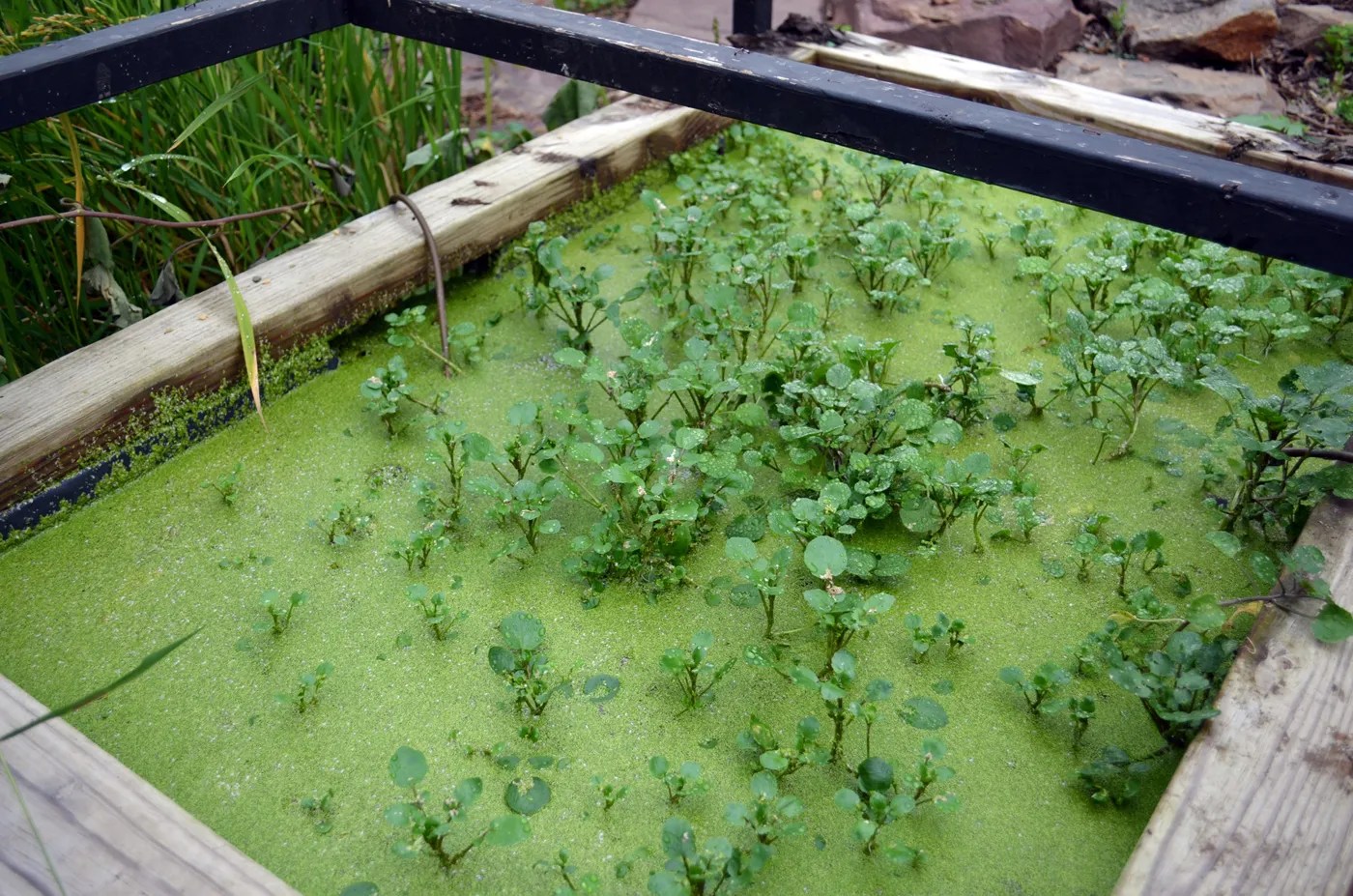
Although the duckweed looks as solid as a patch of moss on a clay base, it is floating peacefully on an inch or two of fresh well water being misted into the bed. The watercress is there, with a few tough survivors poking through the surface and absorbing just enough sunlight to survive the less that ideal summer conditions I created.
Fast forward a couple or three weeks to October 17 and the ratio seems to have reversed. The watercress has exploded and the duckweed, while still there, is submissively co-habitating beneath a mini-canopy of tender cress leaves.

Cooler nights and days with the less intense and more angled autumn sun seem to be suiting the cress just fine don’t you think?

We’ve enjoyed a good bit of harvest in the last week or two following this surprise rally; under current conditions it replenishes itself almost a fast as we can cut it.
As is usually the case, this shows again that the best way to learn about growing things is to actually try to grow, not confining yourself to what the books advise.
You just never know.
Transitions
The transition from the overgrown summer garden of September into the more tame fall/winter garden is slowly taking place.
Overall things are still pretty shaggy, with lots of spent sweet potato and gourd vines stretched everywhere, browned tomato plants inside of cages overtaken by beans (and no surprise gourds too), and ground around and between some beds that appears to have been turned by a miniature disk harrow.
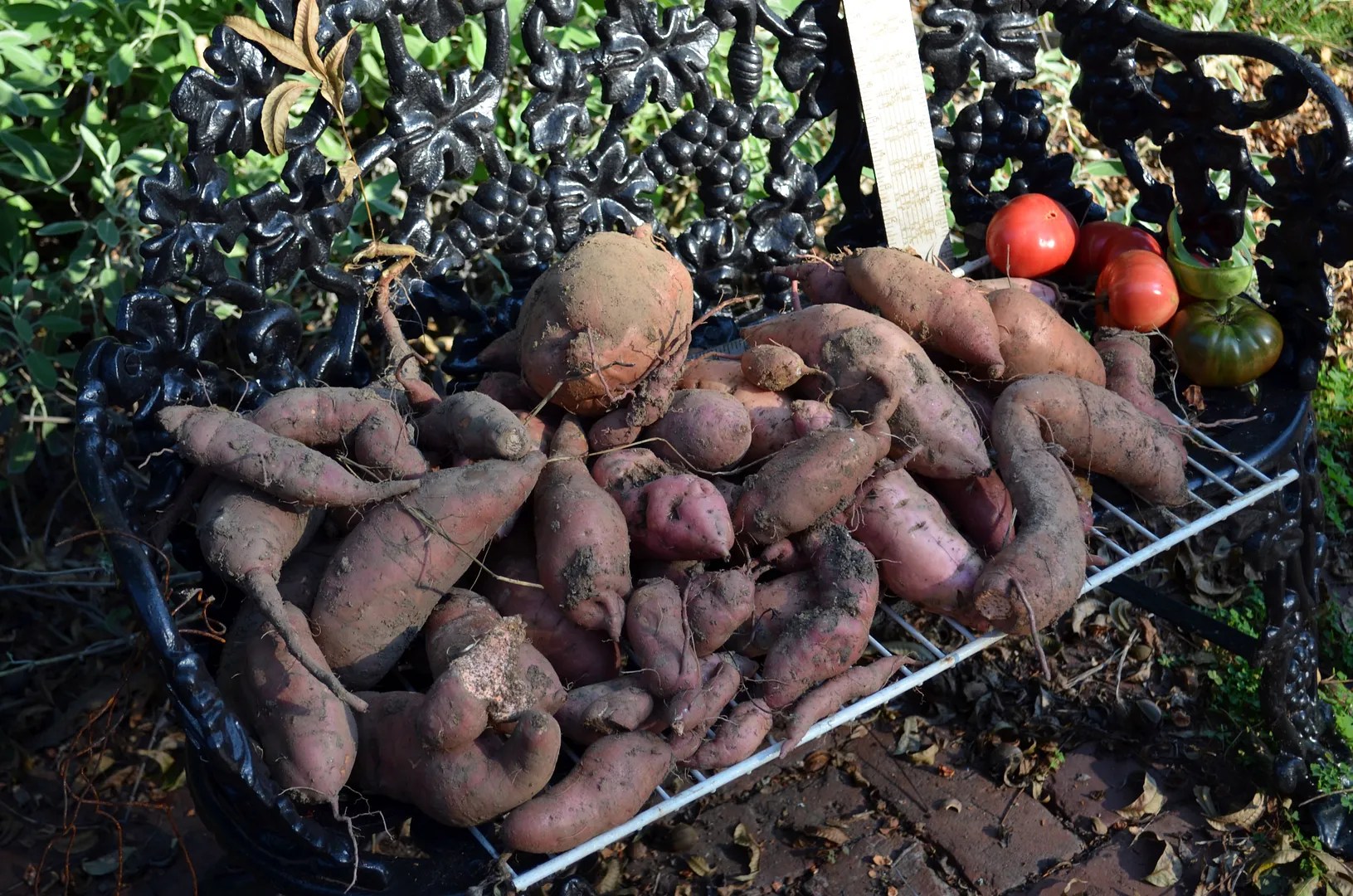
Sidebar: These chopped up patches of what before was level and packed clay deserves explanation here (but will not appear in any photographs.) You may recall earlier posts about the sweet potato harvest and how a few were dug just outside of the bed where the original “hills” were planted. Oddly, the far reaching spurs of these prolific vines did not wilt when chopped and removed from the hills as they were harvested. Further investigation found that they not only rooted as they expanded, but in many cases developed harvest sized tubers several feet out from the bed. In all, another 20-something pounds worth were discovered radiating out from the source. This pushed the total harvest close to 200 pounds, something we were definitely not expecting but are looking forward to consuming. The outliers:
I won’t share the shaggier parts of the garden just yet, but I will share some carefully angled and cropped shots of some of the areas ramping up for cold weather harvests.
In these you’ll see broccoli, cabbage, kale, leeks, mixed greens (turnip mostly), lettuce, Chinese cabbage, kohlrabi, and a spot or two of some vigorously growing volunteer arugula.


The best of the year is yet to come.
Garlic: It’s that time of year
Garlic night, divide, inspect, count up the biggest ones, cull & use the small & damaged cloves.
Six types for 2013

Seed Garlic – Four new types to try + two of my own to replant
The four new “trial” types for our warmish winters here, nekkid.
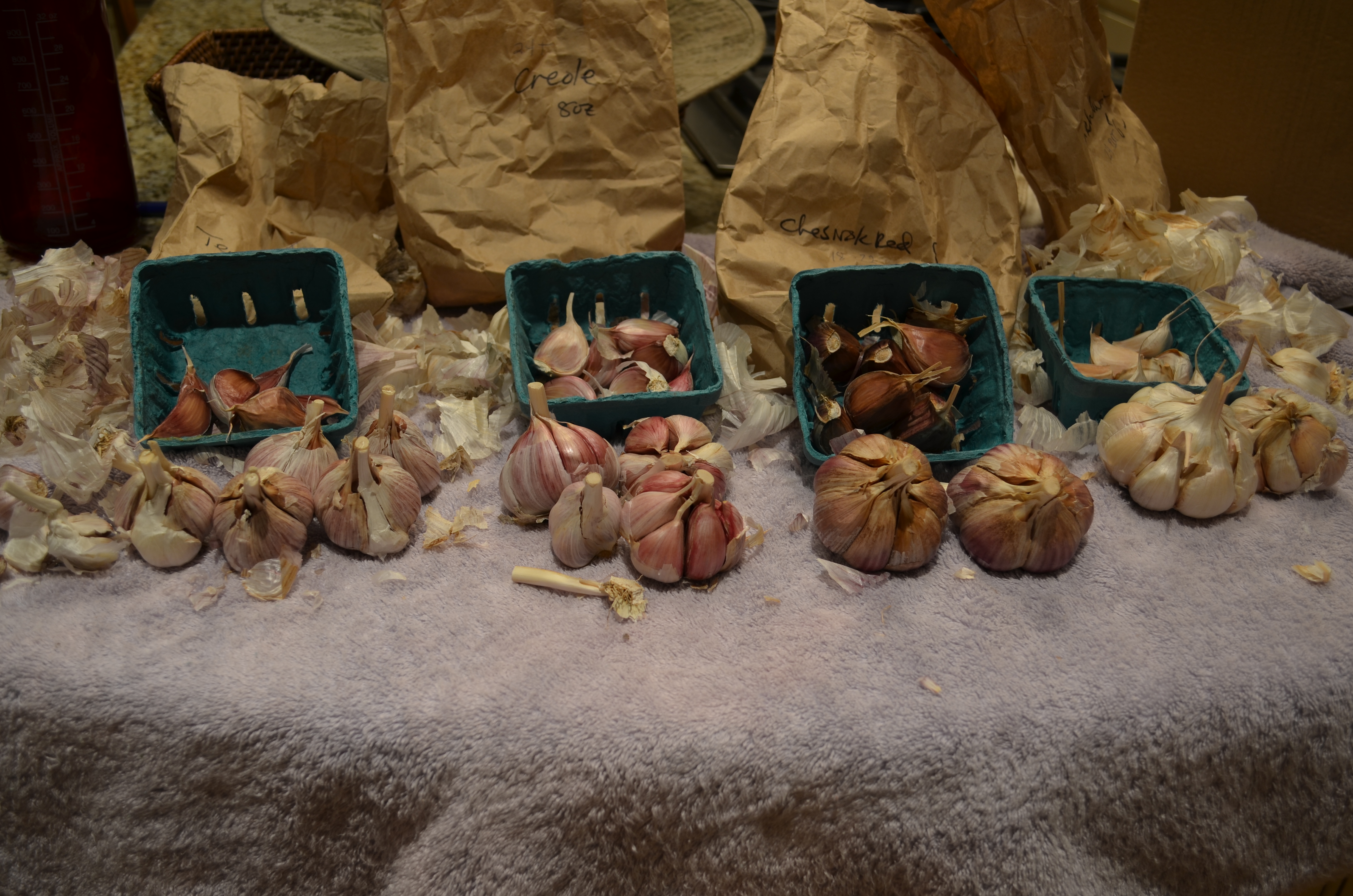
Separate, inspect and cull the small / damaged ones
(I took these and many more pictures for another website that has invited me to write more “in depth” articles for them on a variety of subjects. More on that later….)
Night Lights
I know….. I posted a shot a few months ago but I figured I could do better with a tripod. 😉

LED Bottle Gourd Lights on Lizzie’s Porch
And then it hit me…. I had mutts.
Bushel basket gourds are generally supposed to be a light green in color and roundish in shape, like a slightly flat basketball.
“Normal” would be sort of like these two fatties hiding behind boxwoods amongst the ground cherries and ivy.

Oh, did I mention I also had a couple of apple gourd vines climbing up and over the back fence as well? An earlier picture of a typical apple gourd specimen is re-posted below.

So (duh), why were half of my bushel basket gourds turning out to be more teardrop shaped with an interesting pattern on them? These were all good sized too; perfectly shaped to be a martin house and probably even a little too big for it.
As I said, “duh”.
Perhaps gourds cross pollinate pretty easily and end up setting “mutt” fruit?
DUH.
What do you think?
Normal bushel gourd in front, mutt in back:

That pattern sure looks a little familiar eh…..
Here are some more mutt gourd pics; do you recognize it now?


The stupid part is I knew gourds do this still somehow didn’t recall it from the time I ordered seeds last winter until a few days ago.
As I said, “duh”. Oh well… the good news is I will have a bunch to get creative with by the time they are all dry next year.
Maybe I’ll pursue and new hybrid type and become a gourd tycoon. (Or not 😉 )
Peppermint Buffet
The little peppermint bed was in full bloom a couple weeks ago and was covered up with several types of bees and wasps. Bombus Griseocollis (Brown Belted Bumblebee) and Scolia dubia (Blue-Winged Digger Wasp) were the stars of the day.
The Blue Winged Digger is an interesting critter; the females can detect beetle grubs under the surface. They burrow down and invade the tunnel bored out by the grub; once they find the resident they give it a paralyzing sting and lay an egg in or on it. You can guess the rest of the cycle, much like Cicada Killers it becomes invasion of the body snatchers. Yuck (but cool and appreciated by this gardener, who isn’t fond of Japanese beetles.)
Enough about the gruesome little secrets of nature; instead let’s just look at some pretty insects enjoying their peppermint pollen buffet.
(All pictures click to full resolution if you feel the need to see the expressions on some bug faces.)

Bombus Griseocollis (Brown Belted Bumblebee) surprises Scolia dubia (Blue-Winged Digger Wasp)
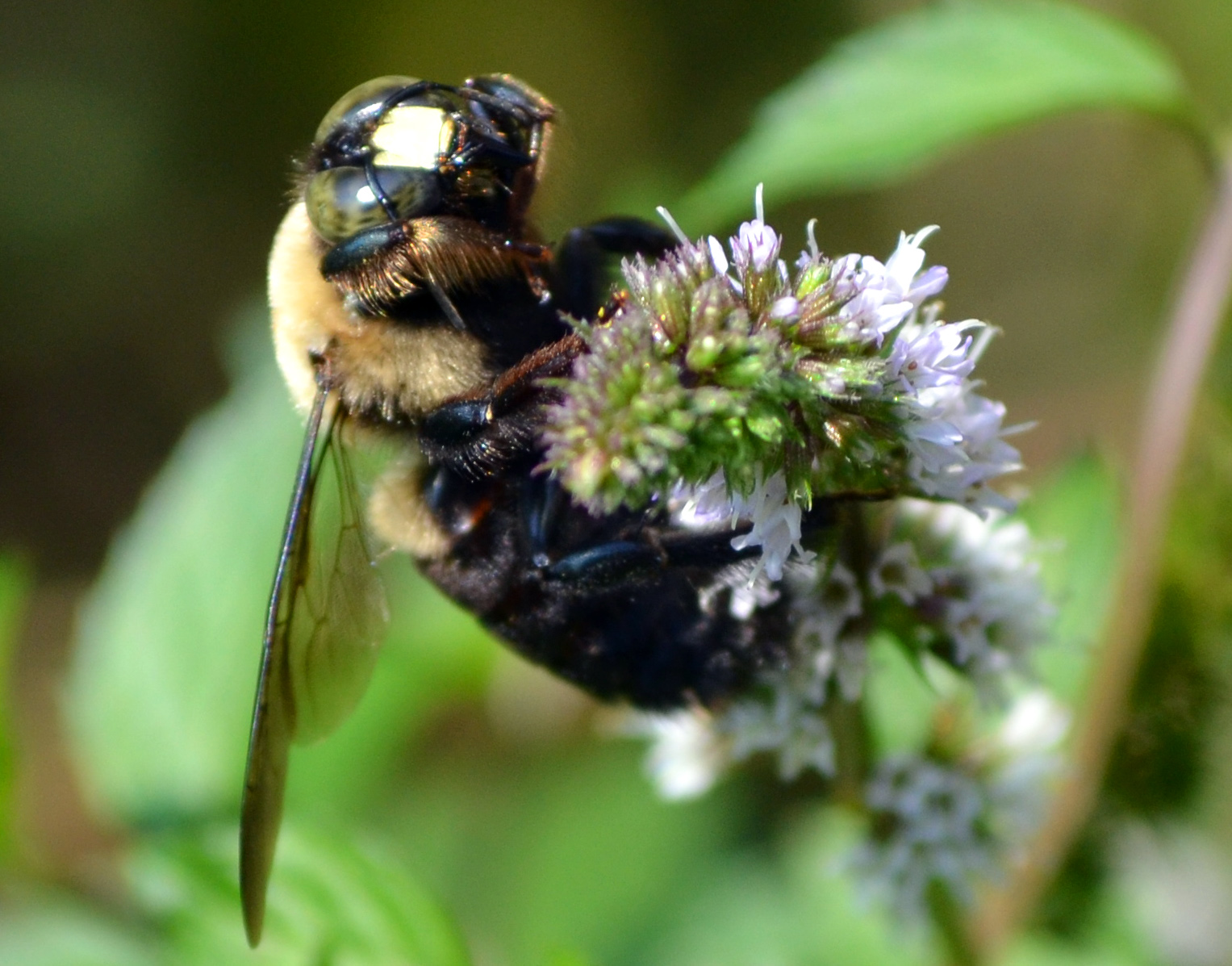
Bombus Griseocollis (Brown Belted Bumblebee)
I think most have heard that bumblebees should not be able to fly based on an engineering assessment of their aeronautics. Look closely at this guy; he has a clipped wing that didn’t seem to hamper him much at all:

Bombus Griseocollis (Brown Belted Bumblebee)

Scolia dubia (Blue-Winged Digger Wasp)

The continuing sweet potato roundup …uh… continues?
This season I’ve learned a little more about these things.
- “Bush” varieties like Vardaman remain tamable in comparison to traditional vining ones.
While herbs may respond incredibly to a daily dose of drip irrigation, sweet potatoes don’t like is so much - If you plant traditional vining types in a raised bed with a wooden border, they escape nonetheless.
- Beauregard and especially Georgia Jet will have large satellite tubers a couple feet out from where the main hill is and they like to hide deeply.
- If you placed a raised bed on the hardest pan clay your garden area has, then fill it up with perfect soil mix with lots of organic matter, most of the tubers will ignore your efforts and become subterranean stalagmites that anchor deep into the clay/chert substrate.
- Every other hill of “Georgia Jet” will contain a resident three-mile-island/Fukushima mega-tater the size of your head.
- Digging sweet potatoes from a bordered raised bed take patience to complete without stabbing or breaking any tubers.
How is it done?
First, find the bed under the sea of vines:

(Found one)

I cut and peel back the vines at a corner then remove some soil by hand to check the edges for tubers before plunging in the fork.

Things speed up once you can get the fork working though

And with a couple small hills remaining, this is what the curing bins look like on the back porch:

Geez… I think next year I may go with something that isn’t so prolific, like maybe guppiers of rabbits. 😉
How to Harvest a Sweet Potato Hill in Just 42 Seconds.
(Including the escapees that formed outside of the hill / bed.)
Gifts From Unexpected Sources
I’ve been pecking away on the keyboard for his little blog project for a little over three years now. The page views are steady (which continues to surprise me considering the slackish effort the writer usually puts into his posting.) and I have accumulated a diverse group of followers/subscribers. All continents are represented and I’ve gotten to “know” some other like minded souls scattered about the world through this project. I’m actually not sure what I was expecting at the time I started but the experience has been (and continues to be) a good one.
A few weeks ago I received an unsolicited handwritten envelope that contained a note, a fuzzy picture of some plants and a tiny foil-wrapped slip of seeds in it. After a second or two of head scratching I recognized who it was from.
This little gift was sent by the spouse of one of mrs cohutt’s childhood friends; they were early followers and among the first outside of “family”. (They visited us one Saturday for lunch early on in this boondoggle so they also know the challenge mrs cohutt has in keeping me from starting the newest-overkill-tangential-garden-absurdo-project every other month.) They do grow a little but their lot is better suited for shady lounging with their monstrous canines; I wondered what seed they could possibly be sharing.
The answer: Mizuna. Not plain old green mizuna, but a purple variety that I’d not know existed before the surprise gift. (If you aren’t familiar, follow this link for a little more info). I was pleased and decided best get them in the ground so a fitting “thank you” could be posted.
I was in the process of finding spots for the early fall plantings at the time and segregated a corner to cultivate this little bonus. I am almost always too impatient to label my plantings at the time the soil is disturbed, but I relegated this little corner to memory then hastily continued with the other plantings scheduled for the evening.
Well, baby purple mizuna looks a whole lot like baby green mizuna; in fact it also looks like baby kale, mustard, turnip greens, lettuce etc. So just like that, the special planting of purple mizuna had been “swallowed into the grid”. This was actually a good thing as it was still August and this motivated me to pay closer attention to all my sprouted fall greens in an effort to conserve and protect the “special” ones wherever they lay.
A few days ago I was able to identify two little sections of mizuna but alas, both were green. My concern was rapidly increasing; did I even plant the purple?

Where are you purple mizuna?
Last night, upon closer inspection (the “get on all fours with reading glasses” type) I detected an ever so slight red tint beginning to feather across the leaves of one of the plots.

Baby Purple Mizuna
(Relief.)
The unsolicited seed packet was a pleasant surprise. Thank you B & K. 😉

 Behind cohutt's fence