Paying (too much) Attention: Hemaris Diffinis
Observing what goes in and around the garden is important; a gardener can often catch big problems when they are still small and hence turn potential disasters into inconveniences.
HOWEVER…….
If one isn’t careful, observations can become work stopping distractions if curiosity overcomes a scheduled task list.
Yesterday I was deadheading blooms and watering parched blueberries when I noticed a small hummingbird… wait, no, a large bumblebee….wait no… what the heck is that thing???
I stalked the skittish creature hovering over flowers of all types and followed the little guy from bed to bed until I managed to catch some half way decent photos.
It turns out this guy is a hemaris diffinis, aka “snowberry clearwing moth” or “bumblebee moth”. Odd little thing, he never landed; he only hovered while tapping the flowers for nectar. I found it interesting but not quite to the extent Bill Oehlke does. 😉
Edit: I sent a link to Mr Oehlke after his site confirmed the identity of this moth; he promptly responded and confirmed that it was in fact hemaris diffinis and that he would like to post the pictures and the sighting in his pages. Cool eh?



That’s all.
Inside Gourd and Gourd Insides
I am just too impatient and curious now; I can’t leave them alone.
First, the Inside Gourd:
I snipped a small one from the trellis that is one of the older ones; it hasn’t grown at all for weeks so I expect that it has a sufficiently thick shell. It is now hanging in the sun room drying:

Second, the Gourd Insides:
I noticed one of the immature gourds on the severely wilted part of the vine had developed a pucker mark on it. It appeared to be collapsing as it dried; I decided this one was doomed regardless and would be a good dissection candidate. I guess this is what happens if the gourd isn’t allowed to stay on the (healthy) vine long enough to grow a thick shell.
Anyway, here you go.
First the outside of the halved gourd, including the obvious puckered dimple that was developing:

And the inside- the pulp was drying out in the top, hence the dimple I suppose.

That’s all….
(I’m certain all the valuable knowledge presented in in this post will change the lives of everyone fortunate enough to view it. )
Rain Catching 102
This is #2 in a series of posts outlining the concept all the way through installation of my 275 gallon rain catch system last year.
My next step was to figure out the amount of water that drained through the convenient downspouts. There are three on the back of the house, one of each corner and one in the middle. The corner ones drain the back side gutters; basically these catch the outside slope of the roof for a little more than the back half. The middle one catches all the inside sloping roof on the house, which as pretty decent sized area.
For simplicity and volume the middle one seemed a good prospect (and it was the most hidden, another plus) so I refined my investigation a bit to see what volume of water would flow with 1 inch of rain.
The formula is approximately .623 gallons of water PER square foot of roof area PER inch of rain. The roof area measurement is constant regardless of the slope; for flat or sloped what you measure is the area under the roof, or more precisely the footprint of the area covered.
My home’s roof line is actually shaped like a “U” open to the back; this crates a canyon of sorts in the back that drains onto a flat roof and then down the central downspout. This would have been a difficult measurement except Big Brother had already made those measurements public record. I looked up my tax record online in the county database and right there for all aspiring rain catch engineers to see I found a sketch of the foot print of the house including the ridge lines of the roof. How convenient (and how scary, there was also a picture of the back of my house that was taken from inside my fence. Does the county send out ninjas to sneak these photos? Drones? ???)
Anyway… the area that dumped down the central downspout was approximately 700 square feet, so 1 inch of rain would theoretically provide 436 gallons for harvesting. If I connected my 5 remaining 55 gallon barrels, then a little more than 1/2 an inch of rain would fill them.
OK, so volume won’t be a problem.
I came up with a visual of what I thought I wanted for my multi-barrel rain catch system setup to do for me:
1. I wanted multiple barrels hooked up in parallel so that they all filled and drained at the same rate. This way there is no spillover or draining hierarchy to contend with and I would be able to drain all from a single point.
2. I wanted the hose connection to be @ the “front” garden beds (the back beds weren’t even conceived at that point) so that I wouldn’t have to drag hoses all over as before.
3. I wanted to have knockout cleaning ports to clean sediment and any other oddities out of the system if needed.
Easy enough, right?
hahahahahaha
Ok the first thing I built was a platform I could use to raise the base level of the barrels. This had to be stout as 4 x 55 gallons of water would weigh over 1700 lbs. (The 5th barrel was going to be in another area). Additionally there had to be gaps in the platform’s decking that allowed for fittings to go through below.
Here is my answer to these requirements:

For scale, a barrel has been placed on it:

Next: Fittings and the connections
Kittehmato
The harvest remains under a watchful eye

Just in case anyone was concerned.
Gourd vine decline II, with pictures
As I was considering adding these gourds to the mix last winter, I searched the web for some decent pictures of the vine’s growth habits. I found a fair number but mainly they were shots of farmhouses and fences covered in what might as well have been kudzu.
I really was more curious about the cycle of the vines and gourds themselves as there were plenty of descriptive black and white print ag/extension bulletins but few worthwhile pictures. Maybe they are out there somewhere but I got tired of filtering through the hundreds or thousands of gourd “art” sites that the searches pulled up – lots of interesting carved and painted gourds but not at all what I was looking for at the time.
You might sense that I am setting you up for a gourd garden picture mega-post.
You would be right, although “mega” might be a little of an exaggeration.
OK, so I followed the suggestion of BackYardFreshFoods (with a name like that, who wouldn’t?) and cut the withered vine in a couple of places this morning to test the fluid viscosity of what oozed out. I wouldn’t call it conclusive but I didn’t get the sticky or stringy consistency I was expecting. I still think this to be a bacterium wilt case after reading more last night but it really doesn’t matter at this point- I can’t stop or slow the wilt in the afflicted vines, so I will keep them all well watered and see how the gourds that are left hanging on the dead vines fare.
Ok, now for the pictures:
Closer shot of the giant wilted void in yesterday’s post:

Close up of one of the wilted vine branches (this is a dairy cow manure compost pile that has composted down to 1/4 of its original mass- ready for bed replenishing this fall.

A shot from back beside the tower along the fence. The green parts of the vine beyond the wilted area is actually another vine planted in the compost pile in the corner of the yard; it is younger and just now really “launching”.)

The trellis netting area also was hit- these are the far reaches of the vines going the other way on the other side of the tower from the area above:

And finally, some leaves that display spots that match the description in the bulletins of squash bug damage.


Not a “mega” picture post but hopefully some other ambitious garden fool will find these next winter, when they are wondering what gourd vines are really like and whether they want to give it a shot.
Thanks for the previous comments and suggestions; I’m really curious now about whether the “mature” gourds are actually developed enough to dry and work with this winter. We’ll see, but I think most are in good shape.
TOE-MAY-TOES
Stank-Hot
It has been 95-102 and as humid as the Congo for 2 weeks now, plus the lows at night haven’t dropped below 80 for a week.
Relief is ahead, if you can call it that, as the lows are forecast to get into the mid to low 70s for the weekend and the forecast highs are “only” 90 for Saturday and Sunday.
Maybe I’ll get some flowering and pollination again on the Brandywines; I haven’t noticed any new fruit setting for a while now. I still have a tomato conveyor rolling but they are a little smaller than July’s average fruit. They’ll perk up again in a few weeks and deliver a final fall flurry (assuming fall is coming this year).
I really can’t complain though- the total harvest is over 1850 now. I’m pulling them a little earlier due to the stink bugs and some tomato fruit worms are getting more prevalent under the dense foliage of a couple of the Brandywine bushes.

Gourd update to follow but I have some tomato processing to do in the meantime. 🙂
Gourd Vine Death and Destruction
A couple days after posting about how well the gourd vines were doing, whole sections wilted and died rather suddenly. I traced them back a bit and it appears that these were branches off of otherwise vigorous vines.
_
What has caused this sudden malaise in cohutt gourd paradise?
_
I find no visible vine borer damage, which is consistent with the season here (August is past the egg laying & larvae season for the moths that bring these joys to the garden).
_
_
Some of the leaves are speckled along the healthy vines, which i believe is a sign of squash bug activity. I suppose the combination of the heat, drought and squash bug encouraged wilt might kill off part of a plant vs the entire plant. Maybe the vines die in stages and my winter gourd labor whining of earlier posts was premature.
_
_
I was about to give up then I pulled up pictures taken earlier in the day, and after careful study I believe I have found my problem.
__
Can this be? Would someone purposely sabotage my gourd bearing garden kudzu?
Would neem oil repel this unusual pest? A strong garlic spray?
I’m contacting Monsanto*- this undoubtedly hatched from one of their evil labs.

>
*To Monsanto’s attorneys: This is a joke. I don’t really believe this creature came from your labs. Do not take this seriously; note the nonsense category this post is included under. m ‘okay?
Rain catching 101
Last year I thought a rain barrel might be nice, so I started looking for cheap surplus food grade 55 gallon barrels. I found some for $16 a piece in Atlanta and sort of bought all I could fit in my truck. If once would be nice, 6 would be fantastic, right?
I gave one to a master gardener friend as a thank you and was left with 5 blue barrels that smelled of grape juice concentrate. Apparently I had already subconsciously decided that this would be a fine overreaching summer project for a July’s 95 degree heat. Shortly thereafter I set off to design a system to catch the rain from my roof and efficiently deliver it to my garden 75 or so feet away.
Things I didn’t think about when I was hauling the barrels back that day:
First, just how would I align the barrels?
Cascading in series had its problems- I decided right away I couldn’t do this.
Parallel systems would allow for all barrels to fill and drain at the same level at the same time and therefore would be the most efficient and easiest to use.
Second, how to get the water to the garden? How much fall did I have and would that generate sufficient pressure? And what is the difference between pressure and flow rate and which would be most important in my applications?
Third, how much rain would it take to fill the barrels if I could design and install a functional system? Would it even be worth it in the sporadic but often heavy rainfall of Georgia summers?
Fourth, how would I handle the overflow?
While I worked all this out in my head, I stacked the barrels back out of the way where I was certain Mrs cohutt wouldn’t see them.
Uh… she did though….

Next: design considerations and beginning the installation.
My gourds runneth over
Mrs cohutt has been hounding me to do more gourd updates; just last night she pointed out that I only had 12 posts tagged with “gourds” and that maybe I was getting a little slack about her favorite subject.
What was I thinking? Maybe she’s right…..after all that’s only 17% of my posts having any sort of gourd theme or reference.
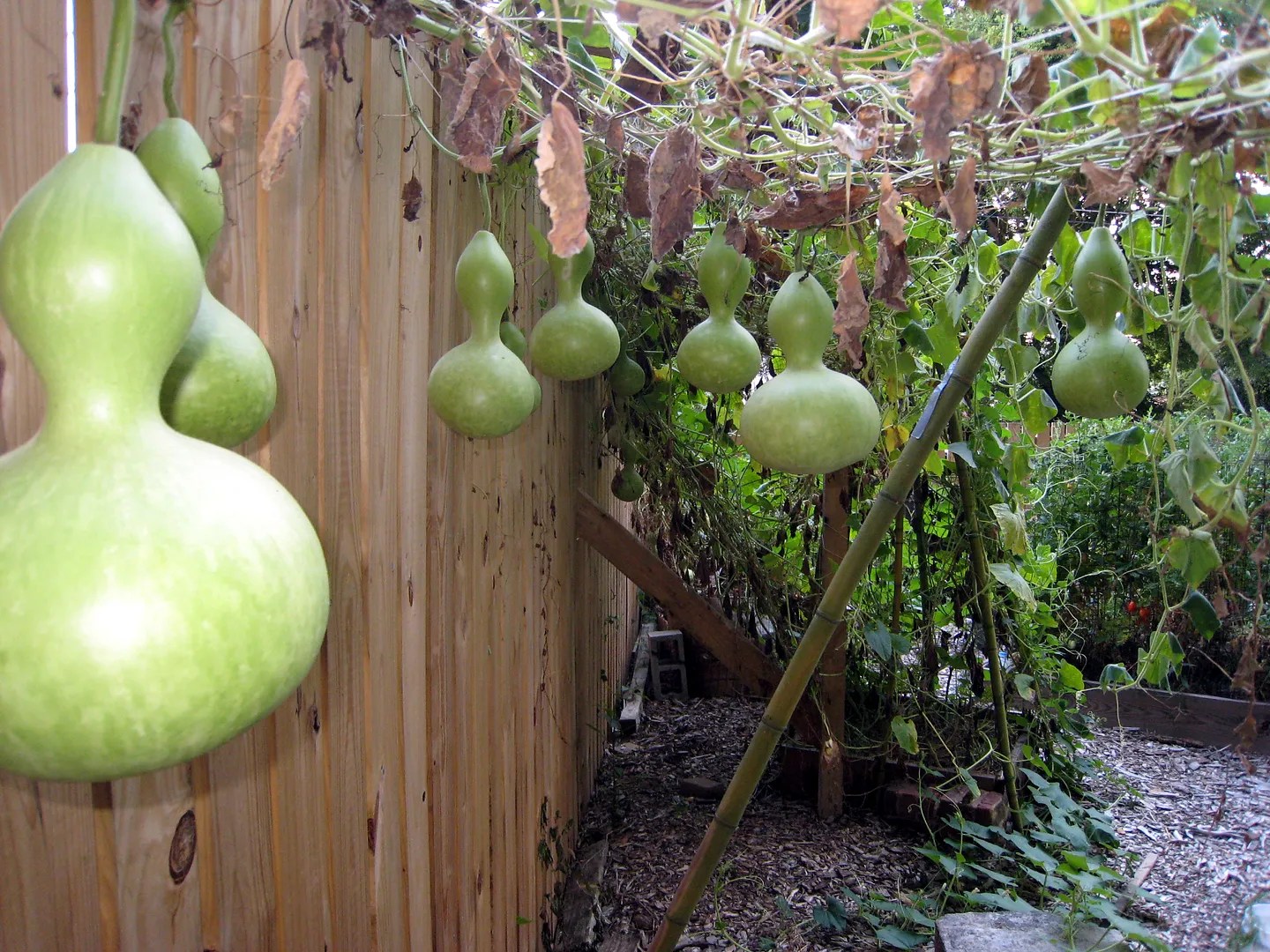
Fortunately, last week I took some pictures of the gourd vines as they were continuing their quest to cover everything within 10 feet of the back fence.
From previous posts you might recall that my good concept / bad engineering bamboo gourd tower was engulfed in gourd glory to the point of tottering over in a storm, then shortly after the top snapped under the rising weight of the heavy fruits (?) or whatever. The makeshift trellis netting canopy was overrun and had to be reinforced with bamboo due to the weight of the gourds.
The twine run from the bed / tower base to the fence were very effective in guiding the vines to the fence, where they continued to extend laterally, up and over:

There is a narrow gauntlet I have to run any time I need to move between the fading Martinos Romas and the mass of green vines eyeballing the open spaces to the north. (I certainly don’t loiter in this area, would you??):

My two wire compost bins are now concealed and the scrap fencing I had placed near the back gate for recycling is covered. (The black garbage can was full of composed cow manure; one morning I came out and it was being pulled into the gourd mass, and I realized there was nothing I could do to save it. For real, look at how the vines are reaching for it. Game over, it is doomed. )

As Mrs cohutt is quick to remind me, anyone can have out of control vines; she says no gourds means all this is just kudzu ……
So what’s the gourd count?
I’ve made several attempts to count the maturing gourds on all the vines and keep coming up with different numbers but all are north of 55.
Well, crap.
I had hoped maybe I could get a couple dozen to set if I was lucky.
Gawd what a way to spend the winter……….

 Behind cohutt's fence