Rudbeckia Hirta
Black-eyed Susans…
I believe these are very difficult to kill but somehow I managed to let 90% of the divisions my sister gave me a couple of year ago die.
A lot of things could have happened… (Shame /on) I am guilty of planting or sowing something and then mistakenly pulling it as a weed months later, so maybe that’s what happened. (Shame /off)
Who knows…
Regardless, I had forgotten about them and hadn’t noticed the plant’s recovery until the blooms exploded recently. (These were hidden behind a mountain of Tarragon in an area that is off to the side and out of the sight line from the sun room.)

So there you have it- flowers do exist behind the fence. As further proof, I offer this bonus picture of my (mostly) purple coneflower herd:

Carry on…
More On That Week Away…
A few more updates about what went on while I was away….
Something found my small chard patch and obliterated it:

The handful of Asian long beans aka “yard long beans” vines sort of, well, provided beans….
(3/4 were too developed to eat as pod beans so I shelled them and we enjoyed a nice pot of summer cow peas.)

The rear artichoke plant showed a couple of new small ‘chokes much to mrs cohutt’s delight:

I had the great idea of inter-planting all sorts of vining plants throughout the garden, mainly in the back half, in order to “fill in” as ground cover.
Sweet potatoes, beans, gourds, melons….
So hows that working?
A little too well, but still barely under control after some vine taming yesterday evening. Considering that gourds and sweet potatoes grow about an inch per hour when it is 90 degrees and it isn’t even August yet, I am now quite certain this task will be continually repeated through mid-September. (Good thinking again, cohutt lol….)
Examples of cohutt’s jungle vines from the back section of the garden follow…
Bushel basket gourds and sweet potatoes, plus some rice and a hydrangea cutting provided by sis last year:

More sweet potatoes:

Apple gourds with sweet potatoes in the foreground:

A week away in July
A week away and the back was within striking distance of official “Jungle” status. I had forgotten how sweet potato and gourd vines grow exponentially when the temperature is over 90…
More when I catch up; for now I offer a panorama shot taken today of the back portion of the garden.
And yes, that is a monster zucchini on the yellow bucket on its way to the compost pile & a day or two past optimum size to say the least…..
Click through to zoom in if you wish (warning, 6MB)

Warning: Vine Crossing
With even more sun this season after the storm took out more trees around me, I decided the best weed block might just be sprawling vines across the bare spots between the read beds. It seems to be effective where the sweet potato and gourd vines have thus far covered, but I knew I’d eventually have a problem moving around in that area without damaging branches of these vines.
Solution: Low catwalk bridges that allow the expanding vines to cross underneath.
The bushel basket gourd vines are practically kudzu now, growing a foot or more per day. The main patch runs to the east (away from the camera and center of the garden in the picture below) and I’ve done my best to discourage them from entering the blackberries and asparagus so far.

However, my access to the back is important, so I pegged together this catwalk system last weekend and the vines have already grown under it (this is the upper/ eastern end of the vines shown above). Still a “construction zone” though….

And back the other direction from earlier that morning, sneaking over a gap in the rice growing in the ditch to catch rinse water from the main well access:

And the first leg of another one, so that access to the okra and tommy-toes on the left won’t be cut off by the sweet potato vines encroaching from the right.

Strange? Maybe…
Functional? Hopefully…
Yeah, well, a lot of things aren’t conventional back here.
Basil (again)
I go something unusual yesterday afternoon: sunshine
So I managed to snap a few update pics that I’ll post over the next couple of days while I’ll holed up @ a business “thing”.
First one:
Last year’s basil success seems to be repeatable albeit after a slow start. I have 5 or 6 kinds this year, with an abundance of the nice sweet globe type as well as large leaf Italian…
Presto, it is pesto time. (Groan)


Miracle of Life (or Death) in Nature
I haven’t posted in a few days (if anyone noticed haha).
Before I explain, I’ll link to this recent post regarding a wild Cockatoos on Laura Rittenhouse’s Gardening Journal. Take a look; I had no idea flocks of Cockatoos fly around down there sort of like our crows do here.
OK, so after reading her post you might have figured out where this is going. Certainly the season’s default weather continuation (generally wet, gloomy and overcast conditions) contributed, but my primary reason is explained/admitted below.
Back on the holiday (July 4th) I began setting up what was to be an incredible post (by the lax standards of Behind cohutt’s fence) showing a beautiful Green Darner dragonfly emerging from the nymph stage (perhaps the original one of the few technically correct uses of the term “metamorphosis”), leaving behind the exuvia, and pumping itself up/hardening off into a full fledged dragonfly “adult”.
In the morning I discovered these two “exuvia” (the dragonfly equivalent of the Cicada shells that are everywhere this time of year here) on the underside of a newish water lily leaf (you can click in to inspect them more closely if so inclined):

Nearby, like a castaway who has just pulled himself ashore from a shipwreck, one of the emerged dragonflies was halfway out of the water, seemingly resting on the edge of a partially submerged lily pad. I noted that it was in a particularly vulnerable spot, served up very close to the edge of the pond as birds began their morning activities. Rather than trying to move this one in its still soft state, I suspended some plastic fencing over that part of the pond to deter birds from snatching it up.
The “ship-wrecked” Green Darner:
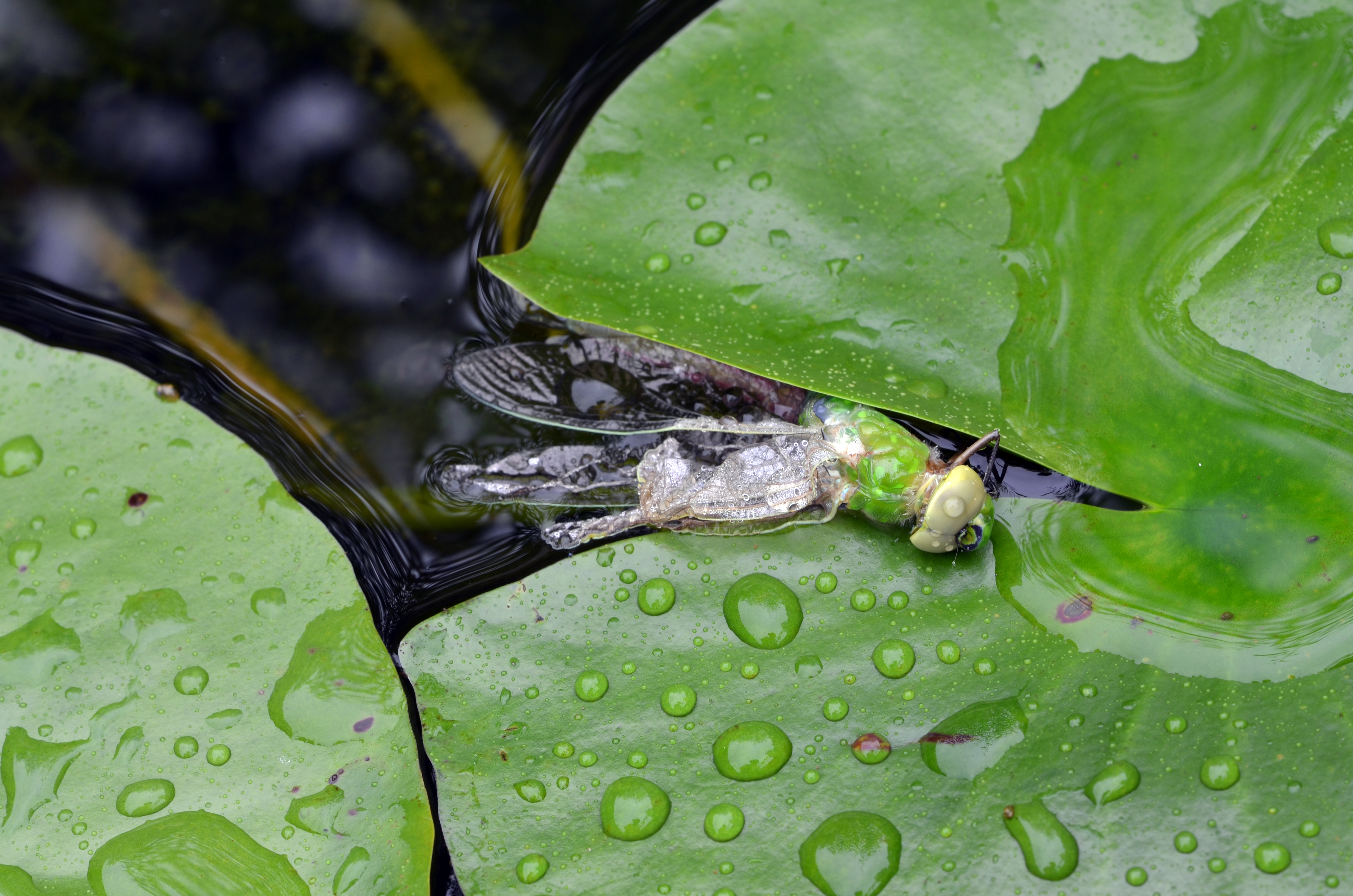
In the 5 minutes or so I was hovering over this fella inspecting the situation and taking these pictures, I was fairly certain I could see some movement. Last year a similar situation occurred and the waxy-winged dragonfly pulled itself out of the water onto a rock and finished the transition process; so I assumed all was well and set up the bird-guard and went back inside to research.
Inside, I learned from Dr. Google that it takes about 1 hour for a newly emerged adult to transition into a fully functional flying predator. Typically they remain on whatever object the exuvia is anchored to while finishing the metamorphosis. Amazingly, they simply gulp air steadily for an hour or so, which expands them in the correct directions/dimensions until they have that classic adult dragonfly body. In short, they pump themselves up and quickly fly away to eat and avoid predators.
Sidebar: An adult Green Darner is pictured below; this is from last summer and possibly a parent of this year’s hatch:

Hmmm… One hour, gulping air, inflating/expanding….. I realized something was wrong and went back out 30 or 40 minutes later to find that nothing had changed; he/she was still lying in the same spot on the same position.
Perhaps the storm knocked it off into the water as it was emerging; who knows, but something definitely went wrong at the wrong time for this guy.
Still, a beautiful little creature with colors and textures only seen in nature, albeit without any life left within. 😦
(Click pic to zoom for closeup)

This really bummed me out more than it should have; I felt responsible for the habitat that attracted them & ultimately did one (or more) in. Yes, it is silly but it is hard not to project too much into the creatures that live and around in my garden. I guess I’ve gone “bug crazy” or something.
In closing, I’ll just say I’m glad we don’t have flocks of old cockatoos flying around north Georgia.
Aren’t you?
Hope for sunshine
The 2013 monsoon continues.
It is hard to actively come up with decent garden blog posts when one is not actively gardening due to the incessant rain of late.
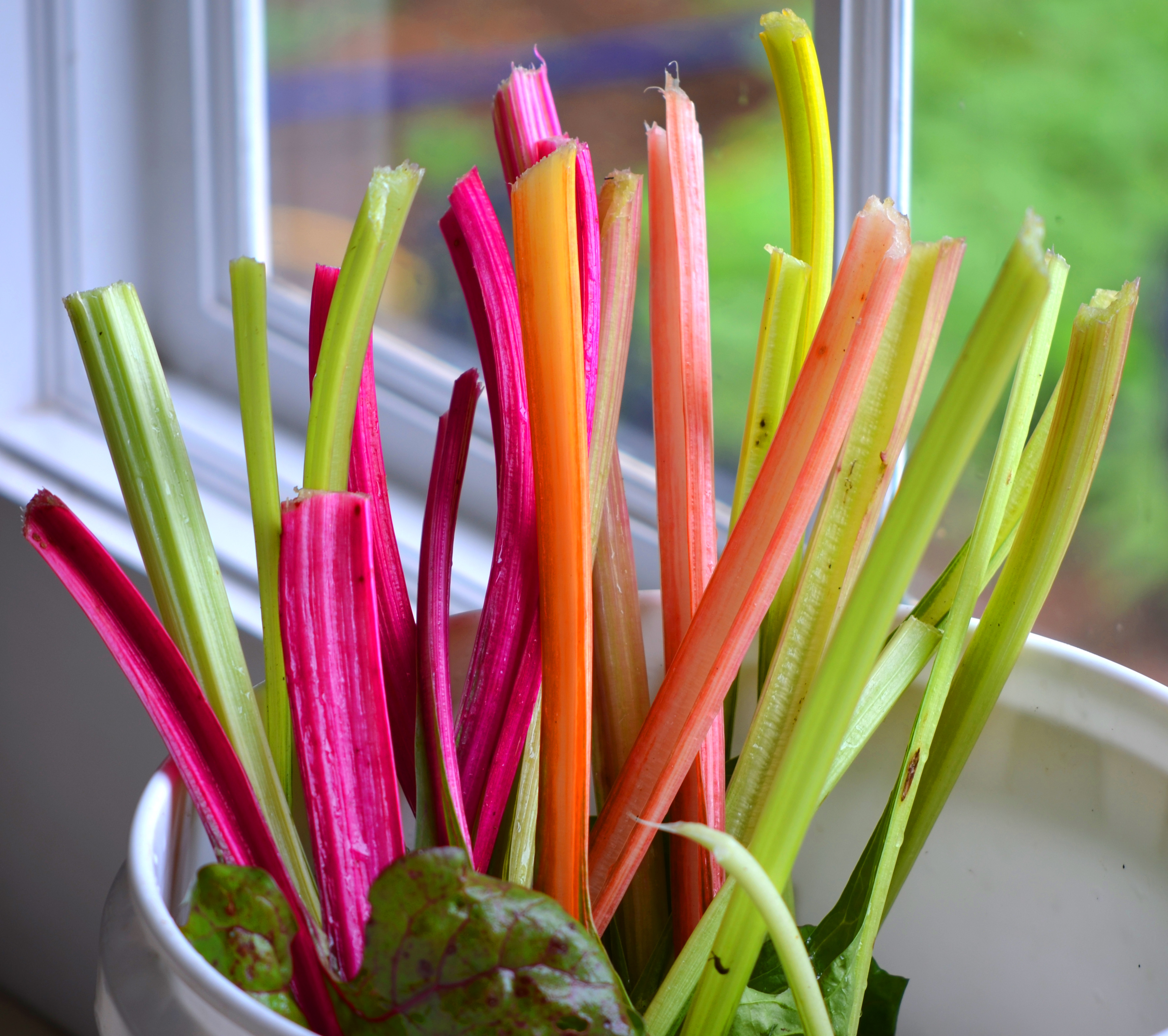
I did manage to harvest some of the rainbow chard for a favorite vegetarian pasta dish (previously posted here back in 2011.
It needed a good dunking due to all the soil the rain spattered up on the stems and under the leaves; the stems were quite striking in harvest bucket once inside.
(Click pic to zoom)
Wow.
Think of how bright it would be on a sunny day…..
July. Monsoon.
FINALLY I have repaired pretty much everything damaged by the storm back in April in between the normal seasonal garden tasks. More than ample rain, while welcome compared to the droughts of the last decade or two, reduced the effective work windows available to get this done.
With the July 4 holiday ahead of me, I find this special weather statement posted this morning:
AN UNUSUAL WEATHER PATTERN FOR JULY IS SETTING UP ACROSS THE
SOUTHEASTERN UNITED STATES. AN UPPER LEVEL LOW IS SLOWLY DRIFTING
WEST AS THE BERMUDA HIGH STARTS TO BUILD IN FROM THE EAST. THIS
WILL LEAD TO THE DEVELOPMENT OF ORGANIZED THUNDERSTORMS OVER THE
AREA. AT THE SAME TIME…A DEEP PLUME OF TROPICAL MOISTURE IS
FORECAST TO MOVE INTO THE PEACH STATE TONIGHT THROUGH FRIDAY.
THUNDERSTORMS ARE FORECAST TO CONTINUE DEVELOPING IN EASTERN
GEORGIA AND GRADUALLY SPREAD OVER THE STATE THROUGH
THURSDAY…AND SHOULD GRADUALLY END ON SATURDAY. RAINFALL FROM
THESE THUNDERSTORMS ARE EXPECTED TO BE ANYWHERE FROM 2 TO 4
INCHES…WITH LOCALLY HIGHER AMOUNTS POSSIBLE.THIS DEEP PLUME OF MOISTURE IS SIMILAR TO OTHER SIGNIFICANT
FLOODING EVENTS THAT THE SOUTHEASTERN UNITED STATES HAS
EXPERIENCED IN THE PAST FEW YEARS. THUNDERSTORMS THAT DO DEVELOP
WILL HAVE THE CAPABILITY TO PRODUCE A LOT OF RAIN IN A SHORT
PERIOD OF TIME. THUNDERSTORMS THAT TRAIN OVER THE SAME AREA WILL
LIKELY LEAD TO FLOODING OF THOSE AREAS.
Great. The ground is so saturated already that the water from my rinsed “harvest bucket” actually pools for a little while before being absorbed in a couple areas of my yard.
Enough whining. If it rains tomorrow, I’ll work on the table refinishing project that is cluttering my back porch.
In the meantime, some updates:
The back shed, as straight and fixed as it is going to be (the stuff strewn around has been mostly moved back into the shed now). Note the lack of the forest thicket that once existed behind it to the east.

The “drainage ditch” and settling pool from the area around the main well faucet next to the shed. As you can see, rice likes this damp little ditch.

Gourd vines have come alive; they have doubled since these pics about a week ago:
Apple Gourds:

Bushel Basket Gourd:


Watercress Expirement, 4 weeks later
(Actually it has been 5 weeks since this year’s watercress scheme post, but these pictures were taken a week ago.)
So how has it worked out so far?
Well after about 2 1/2 weeks I was quite discouraged as the filamentous algae was blooming while the cress was still looking as if it was still in transplant shock. Duckweed had also popped up and it seemed like this experiment would be over before it started.
My best guess was that the very clear water (from mist nozzle spraying cool clear well water into it 24/7) and direct sun were feeding the algae’s exponential growth at the same time the sun was stressing the cress.
I remembered that I still had a 4’x4′ frame that held two shade cloth panels from a summer lettuce experiment a while back. Conveniently, it fit over the watercress pool/bed/paddy perfectly so I set it up and waited to see if it helped.
Boy, did it help. The shade tempered the algae growth and encouraged the watercress growth, which it turn began to provide more shade over the water which further impaired the algae. The only issue was that duckweek seemed to prefer the shade so it grew a lot faster as well.
This is what the cress looked like a week ago, and the last week has brought notable improvement in the amount of cress (it has doubled). You can see the mist nozzle in the top picture; it has a high enough flow rate to run enough fresh water though the bed to keep it crystal clear and as well as keep the larger lower patty full of rice filled. (Seeing as how the rice paddy was also used as a frog orgy host, I have been more conscious of keeping the water level up for the tadpoles. )


I snipped off the tops of the cress in a small section (maybe a little over 1 square foot) and it provided much more that I expected. To separate the duckweed I ran cool well water over the cut cress and agitated it enough that the duckweed came to the surface and floated over the edge of the tupperware.
Verdict?
Delicious, and this small plot is likely more than enough to provide us what we need this year.
By the way, the “weed” grass growing in the pictures is actually volunteer rice from last year’s rice harvest.

 Behind cohutt's fence