Dragging My Feet, But So Is Winter…
Here it is a quarter of the way through November, and as of last weekend I had put forth virtually no effort towards the planned (smaller ) polytunnel/hoop-house for this winter.
I thought last season’s attempt, although quite functional, was a little wide and low plus it covered more space than I needed. So this year only the longest two back beds will be covered (vs all three).
The ribs I made last year were 24 feet long; I hoped that these would work once I removed the 4ft extensions on each, which would save some cutting and rejoining time. The footprint would be roughly 10’x20′ vs 16’x20′ last year.
Presto, the 5 minute structure I threw together for perspective passed the eyeball test and I’ll go with this basic dimension (with additional ribs of course):

Winter is looming, I’d better get busy….
Elections, Gardens, and Fat Cats
Thank god this election is behind us; as is usually the case, we get what we deserve…… the world won’t end for the 50% of the population disappointed this morning, nor will it suddenly be nirvana for the 50% of the population who have voted “their guy” in again.
Here behind cohutt’s fence, we’ll continue to take care of ourselves to the best of our abilities, focusing on improving our self reliance and self sufficiency. This would be the case regardless of who happens to be in any office at any level of government at any given time; we know that ultimately are responsible for our own well being regardless of what Washington or City Hall may do in the meantime to make it either easier or more difficult.
Some say the whole game is rigged, controlled by Washington and Wall Street “Fat Cats”. Maybe so, but we don’t need them here…
We have our own.
😉
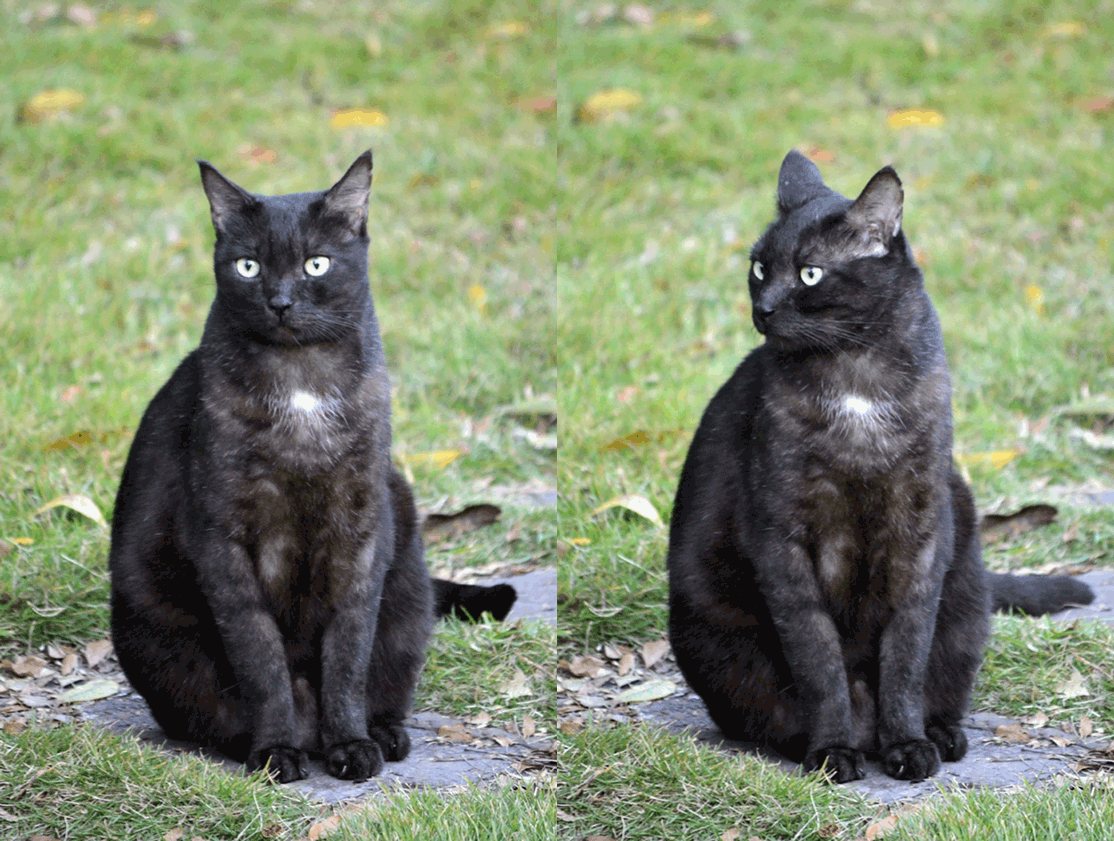
(Did he just move?)
Herbs and Winter
Last year I discovered that some basic herbs do quite well in my zone 7 winters; dill and flat leaf parsley struggled a bit during the summer but then took off once the weather cooled.
The same thing is happening this winter, as the offspring of those plants have taken advantage of good soil and ample water. I didn’t plant any of either, in fact I tried to harvest and save as much dill seed as I could but apparently dropped quite a bit in the process.
Year two for this patch of flat leaf Italian parsley is a good one; the flowers attracted all sorts of tiny bees and wasps all summer and then dropped seeds to regenerate the bed. I never thought I would see anything out muscle the oregano (mostly behind it but barely visible to the right of the parsley in this picture) but the parsley is giving it a run for its money.

The volunteer dill is much less “leggy” than it is in warm weather; it has much shorter and many more stems full of aromatic leaves (needles?). I sprinkled a trace amount into the grilled ciabtta/cheddar sandwiches we ate for lunch last Sunday and it provided a subtle touch of dill flavor, just enough to be noticed but no more. You can see a fresh volunteer in the foreground, among the baby arugula surrounding the larger dill plant. Some dill herb bread may be in order this week…

The fine needled rosemary bush by the middle tool shed has taken hold; it was tiny when my daughter’s future in laws gave it to us as a gift 2 or 3 years ago. Remarkably I didn’t kill it (my luck is that this plant would be the one thing I would screw up, but it lives still) and it has grown into a nice sprawling specimen. The branches are less woody, the needles finer and the aroma more subtle than the monster rosemary bush in the front corner. Rosemary makes it through 95% of our winters without damage and IMHO is a nice addition to the shed corner (along with the confederate jasmine vine finally taking hold behind it.)

I’m curious to see how the peppermint does over the winter; I expect it will be relatively hardy and able to survive without much trouble.
I learned something about raspberries when I took the following picture; if a raspberry cane comes withing 2 inches of soil it immediately sends roots half way to China, even vs a rather thick peppermint patch. (I pulled these 5 or 6 rooted canes after taking the picture; I’m afraid that the other 60 or 70 that aren’t in this bed are going to get a good fossil fuel powered mechanical thrashing next spring.)

Fava Winter Test
Fava beans (aka broad, field, horse, or windsor beans) are supposed to be a great winter crop in my zone, hardy enough (to 15 degrees) to be planted in the fall in order to grow out during the winter. And seeing as how my infatuation with winter gardening remains strong, I decided these would be a good one to try for my zone 7 plot.
If successful, I’ll have a tasty high protein harvest sometime next year (February? March?). Even if these don’t yield a single bean, there is still a substantial benefit to the soil.
Actually a vetch ( more precisely a “vicia”) , favas are legumes and can fix a substantial amount of nitrogen into the soil of otherwise unused beds. They are often used as cover crops by commercial growers and in wildlife food plots.
I’m struck by how stout the stalks are; the plants are fairly sturdy so far and held up well against the relative gales we have been experiencing over the last few days. I was also surprised to see that I have flowers on some plants already given that it is only Oct 31 and this is a “winter” crop.
Regardless, this is what a bed of favas looks like in North Georgia in late October, just in case anyone was wondering:


By the way, when I ordered the seeds, I had no idea that you have to effectively shell them twice. My top bean sheller doesn’t know this yet; I think I’ll wait until the 5 gallon bucket of “Christmas” limas is completely shelled before I mention it….
The Official End of the Summer Season
The forecast for a freeze tomorrow night has abruptly cured my winter-denial-procrastination state (and it was so nice having peppers and broccoli coexisting in the same garden…….)
So today I got busy and harvested a few jalapeno and poblanos, and was much less discriminating than normal about their size since anything on the plants will be toast in 36 hours.
The poblanos surprised me; I hadn’t harvested many by the time the unusual heat of mid summer had set in and temporarily shut down pollination. The same occurred in August after a modest break but my single plant kept growing throughout thanks to the drip irrigation system. This nice specimen of a plant had quite a bit reserve production capacity by the time September’s cooler weather arrived.
Capacity? Production?
I harvested all of these off of my one poblano plant today:

The same was true with the four small jalapeno plants scattered around the garden this year. The plants were smaller than last year but absolutely covered with clusters of beautiful peppers:


The 5 gallon bucket sharing this picture with the poblano harvest offers “proof of jalapeno bounty”:

I realized I still had beans to harvest and turned my attention to finding all of the “christmas” lima beans hidden within the two bean towers, even employing a ladder to reach the tops (sample below):

After a few minutes combing through the thick leaf cover it dawned on me that there was no need to avoid damaging the plants (duh) so I just cut them at the base, toppled the towers, and then cut and combed through the vines for the last harvest.
Afterwards, we had the yellow bucket filled with mostly mature limas for my best lima sheller to work on, plus the view past the shed to the back has been re-opened:

Darkness beat me to the finish so tomorrow I will pluck the last okra of the year from these scraggly, towering plants:

Hello winter…….
The Good Stuff Is Coming
The “good stuff” is almost here, tasty and nutritious fall garden bounty.
Nothing beats a productive fall garden.
IMHO, if you have only grown produce in the warm months you are missing out on the best part of home vegetable production. The best harvests of the year will be upon us in a couple more weeks, after a gentle frost or two perhaps.
Trust me on this and try a fall garden (and check out the samples below):
Broccoli

Cabbage


Bok Choi

A mix of greens

Kohlrabi, Rutabaga & Spinach

Shallot Theory
Yesterday evening it dawned on me that procrastination was winning and I had no shallots in the ground. This isn’t a crisis (yet) by any stretch as some don’t plant their shallots until the very end of winter when spring is lurking just around the corner. (If I have any left in February and remember to do it, I’ll plant a few to compare against my generally successful fall planting scheme.)
So what then is my shallot theory?
First, consider how straightforward garlic seed clove selection is, as covered briefly in my post here. Bottom line, cull the largest heads and plant the largest cloves and over the years you will develop the best stock for your particular garden spot.
It isn’t so clear with shallots. Like garlic, shallots are alliums but they have a different growth pattern. A single garlic clove will grow into a single bulb with a single stalk growing from it (the division happens at the end of the growth cycle and the bulb is harvested before cloves separate); a single shallot will almost immediately start division. You will see multiple “stalks” emerge from the ground and ultimately there will be an individual shallot under each.
So how to grow bigger, heartier shallots that are closer in size to those in the produce section and in glossy garden catalogs?
The interweb has all sorts of opinions floating on this but after some consideration my conclusion as follows:
Big shallots produce a higher number of smaller shallots the next year. (They don’t keep as well as the smaller ones either, so eat them early or plant them.)
Small shallots grow into fewer larger shallots the next year, sometimes just one very large shallot.
This is the pattern that potato onions follow, so it makes sense that shallots might follow the same path..
So…. I’ll plant some large ones to make sure I have plenty of “seed” for next year and small ones so that I might not have to peel quite so many when I cook with them.
My shallot theory will be tested this year as I will actually document what has been planted when and where; consider this post the first stab… (I lost my notes from last year and you absolutely cannot remember what, where & when you planted anything without notes.)
First a handful of shallots were pulled from storage and sorted by size; these ranged from slightly larger than my thumbnail on up to something between a golf and tennis ball:

The larger ones got their own section with more generous spacing than the smaller ones, maybe an 8″ grid..

I spaced the smaller ones 5″ apart in 8-10″ spaced rows in a couple of beds where I had some room:

(Dang that is some nice looking soil isn’t it?)

A word about depth:
Shallots shouldn’t be planted any where near the 2-3″ depth of garlic cloves. As division starts the shallots benefit from being closer to the surface (where they can spread/sprawl) and the rule I follow is to press the shallot into the ground just deep enough so that the tip is at or slightly above the surface.
And that’s about it…..
Two words (and no gardening)
Dry:

Wet:
Strange Foods
Purple Kohlrabi.
First taste.
Peeled, sliced, eaten raw as well as added to spicy garden salad.
Like a sweeter radish with a slight broccoli taste.
Will plant more of these.
Nutritional. (How could it not be, being a cousin of broccoli and kale?)
Click here for nutritional info..

(Click picture for full screen view)

 Behind cohutt's fence