July Rice Update
The rice has been slurping up water during this hot spell but hasn’t seemed to suffer in the least.
To the contrary, it seems to have turned growth up a notch in the last 2 weeks. The rice plants are around 3 feet tall now; the upper paddy’s direct seeded plants have closed the gap a little and are approaching the size of those in the lower paddy that were transplanted a few weeks earlier in the season.

As you can see, the July garden status is “lush” and the paddy is thriving; I like this stage of the season because my slightly-too-close-together beds haven’t merged with each other as of yet.
(Although it is getting rather cozy back there.)


The initial seed stalks are beginning to appear from inside the round interior stalks of each plant; I’m really curious to observe how the process goes from here.

Closer:

This is going to be interesting. 🙂
Grand Central Station

As the unusual heat and drought extended into July, the insect activity on the pond steadily increased and eventually qualified for the “epic” classification a couple days ago.
They all could care less about humans when they are near or on the water; nothing is aggressive, nothing cares about who is drinking next to them.
A minute or so of a very busy spot, best viewed HD in full screen:
What’s going on here?
Is there a correlation?
Specifically, between these two phenomena:
This, a poodle enjoying the holiday, turning his back to the window and obviously distracted by five toys:

and
This, a surveillance photo taken through the 200mm zoom, of a whole Roma tomato being lifted and devoured by a tree rat:

?
It would seem so.
😦
Dragonfly Metamorphasis
The dragonflies are very active now; I have even seen a couple of them immediately after they morphed out of the nymph stage.
For example, this is the just abandoned nymph exoskeleton of a Blue Dasher:

The nymphs spend time both in and out of water as they approach metamorphosis; from what I can tell they usually attach to a stem or leaf and leave their “body” behind, still clutching the perch like a cicada. I’m not sure why, but in this case it appears the exit was done on the edge of the rock; a few inches away, the brand new dragonfly was slowly stretching everything out. (It isn’t the best picture, but with nature sometimes you have to take what you can get.)

Contrary to what you might expect after seeing this picture, the dragonfly was very much alive and gradually wiggling his way out of the water towards the cover of nearby plants. Initially their wings are wet, milky white and quite compressed; likewise their bodies are short and relatively plump when compared to their final dimensions.
Eventually, the new “hatchling” above will look like this adult sitting up proudly on a pitcher plant leaf overhanging the pond:

As with birds, male dragonflies have vivid coloring and the female colors tend to be more subdued and neutral. As I was trying to frame the picture above I noticed this second dragonfly below on the water lettuce:

Given the darker coloring with just the slightest tint of blue, I assumed this was a female Blue Dasher. Nature confirmed this a few minutes later (or else I was a witness to dragonfly cross breeding. 😉 )
Panning out a bit, your can see a nymph hanging out nearby as well. It this wasn’t its time to hatch; it crawled around a bit then returned to the water.
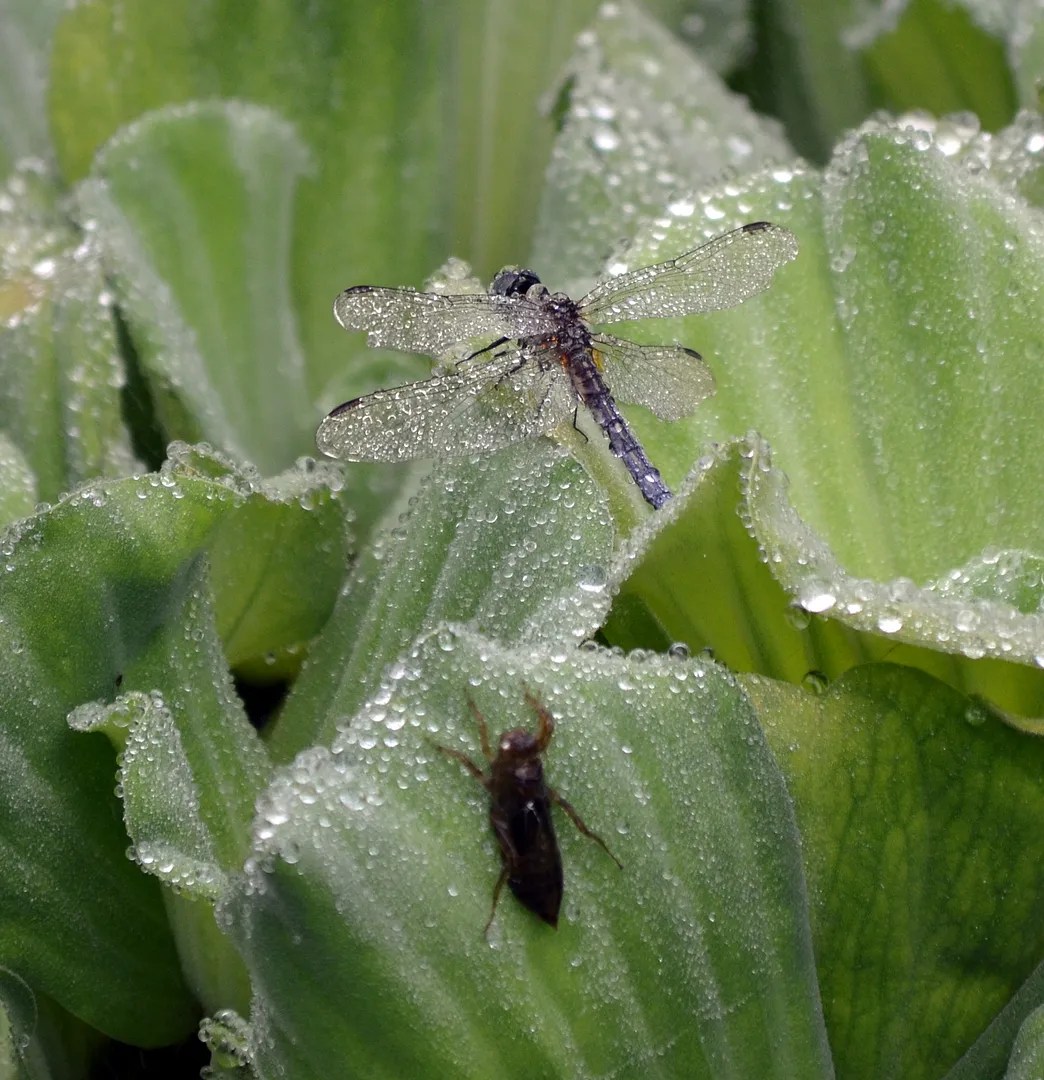
What you can’t pick up from the pictures is the constant motion, the darting and jockeying of the males. The female’s presence had at least three males (including the one above) in a tizzy; for a while there, any time one would land, another would buzz up tauntingly only to be challenged and chased off by the one on the perch.
This short clip isn’t NatGeo quality but maybe you get the idea:
That’s it for dragonflies today.
Note: We received a modest late afternoon shower, the first in a month or so. I’ll be curious to see if my male toads show up at the pond again tonight and “serenade” any females within earshot.
Dill Weed vs. Dill Seed
I’ve tried to grow dill in the past but overall have been disappointed in both the quantity of dill “leaves” available for seasoning as well as the relatively short harvest window in the north Georgia heat.
Maybe I should have done some research before eh?
Last summer’s attempt gave virtually no germination (it was perhaps late May when I planted and already quite warm.) In the same area the parsley germinated but it was sparse, even under a shade cloth tent.
As the weather cooled in September and October, all those dormant seeds came to life and soon I had a large stand of flat leaf Italian parsley with a few hardy dill plants along and in the edge.
These dill plants were modest, but like the parsley, they did just fine in the cool fall temperatures and survived the mild winter without damage. Since then the biennial parsley has gone to seed with a vengeance (still doing it) and the dill has matured into tall but leggy plants with only modest “leaves”, ie virtually all stalk, example below of perhaps my largest and leafiest branch of dill of the season:

The dill has bolted as well and when I passed the tiny yellow spreading “fireworks” type flowers the other day (see below) I caught a bit of the greatest dill aroma I have ever smelled.

(Note the wimpy hair-like leaves below the blooms; the rest of the plant isn’t much better.)
The intensity of this aroma held my attention so I did some research and figured a few things out. (Don’t laugh, being s-l-o-w on these things is typical for me.)
First, the “weed” or leaf part is used for seasoning and pickling etc as I thought. Examples: a little with butter on new potatoes, on baked salmon.
Second, the “seed” part, is also used but it has a slightly different aroma/flavor and is used more often than not in different applications. Actually, the spice of the seed isn’t just the “seed”, instead it is the whole “fruit” or husk that is left behind by each tiny bloom with a seed buried inside. It has a stronger flavor/aroma than the leaves but is slightly different, similar somewhat to caraway seed.
The elves of Google find several baking and soup recipes listing dill seed as an ingredient; I will experiment with breads, maybe substituting the dill for caraway in a rye recipe? perhaps I’ll pay homage to James Beard and try this knarly sounding cottage cheese/onion/dill bread.
Dill, post flowering, drying on the stalk in a fireworks or umbrella pattern:

A close up of the seed or “fruit”:

So what is the point of this rambling post of an herb most cooks already know and use?
None really. 😉
Slicers
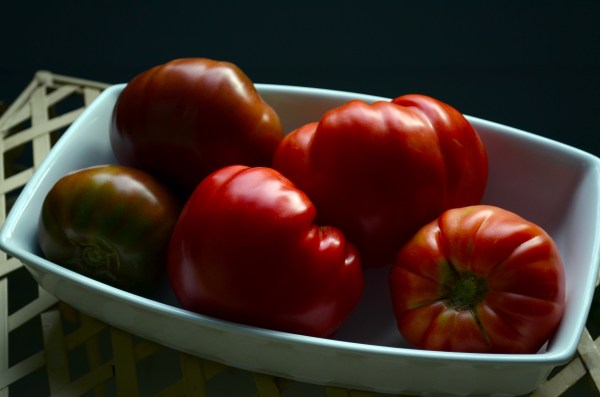
The first “slicers” of the season were about ready as the sun went down last night; these are “Brandywine” & “Cherokee Purple”.
At 7:15 this morning our main AC compressor made a sound like a train derailing then went dead.
Did I mention the high is supposed to reach 106 today according the the National Weather Service?
I suppose it is time to break for lunch and eat some cool tomato sandwiches under a fan… (not much is going to get done around here today).
Relief from Hell, Dragonfly Style
This is from the screenshot of my local weather forecast as of 8:32 PM:
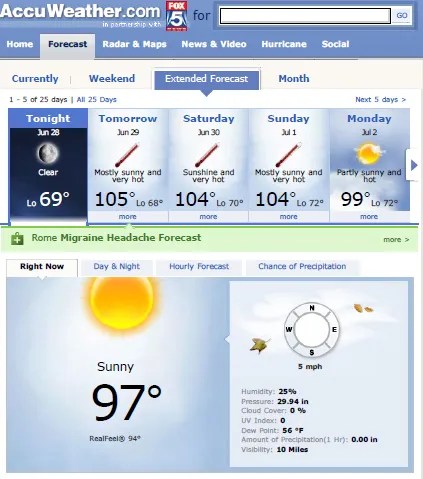
If you haven’t figured it out, this is the “Hell” referenced in the title. It was over 100 all afternoon; 97 is pretty good in comparison even if only a few minutes before sunset.
So needless to say the pond was as popular as ever this afternoon, especially since I left all four misting nozzles running all day.
I like this guy’s solution; after jockeying with other males all day he planted himself on one of the pitcher plant leaves on the edge of the mist:

He didn’t seem to give a rat’s arse about me fumbling around the edge of the pond trying to get set up for a decent shot of his cool perch.
This looked tempting enough for me to briefly consider joining him:

In the meantime, the buzzing Bhishti were fetching more water for the hive too.

(What’s a Bhishti? Hint: Gunga Din. Wiki: Bhishti )
Bees and Nasty Filamentous Algae
First, the filamentous algae:
Filamentous algae is also known as “pond scum”, and right now I have quite a bit in the frog pond.
This isn’t all bad; the algae provides great cover for the tadpoles and likely is grazed upon by the same…. Additionally, this goo is useful as a water conserving garden mulch and adds decent nutrients as it decomposes into the soil.
I fertilized the pond early after it was filled in order to jump start the ecosystem/food chain. I knew I would have some algae and actually wanted a little; the algae will be less aggressive when the water is completely shaded by the water lettuce and hyacinth.
And the bees:
I have been encouraged to see that I have honey bees active in the garden again this year; the last two seasons were pretty much with out them. They have covered the catnip blooms for several weeks from dawn until dusk and recently I noticed that they had joined the various types of wasps visiting the pond.
The odd thing is the honey bees always land on the algae and at times each clump has 4 or 5 or more “grazing”, or so I thought.
Bees on algae (yes, I will rescue my water lily from this soon):

A closer shot:

So what is the deal?
After investigating a little on the all-knowing interweb, I have learned:
Bees need a lot water, especially when it is hot. Besides using it for their own hydration, workers constantly bring it back to the hive where the water and the air movement from hundreds of pairs of buzzing wings create a cooling evaporate effect.
They can’t just grab water anywhere; they need a reliable source of water with certain attributes. “Reliable” means it is in one place and remains available for the assembly line of water transport to be effective (the bee “bucket brigade”). It seems bees aren’t made for swimming (duh…) and a slip into any sort of water is pretty much the last dip a bee will ever take. They prefer water level perches, such as floating plants or in the case firm islands of filamentous algae aka pond scum. The algae floats but the surface is always wet and there are numerous low spots with tiny pools of water along its surface. Floating plants that remain steady aren’t really found in moving or circulating water, so the miles of river that weave through downtown here don’t form the ideal bee watering hole.
So now my little pond and its calm clean water and surface covered with natural landing pads has been discovered by a hive somewhere to the northwest of me (the only direction the water transporters fly towards when they leave the pond).
We are in yet another drought here. Temperatures have been in the mid 90s for a couple weeks and are forecast to press 100 over the next several days.
So I’ll leave the nasty algae (or most of it) right where it is for the bees (and tadpoles I can see scurrying about underneath).
Who knew?
Just Add Sun
(And of course, water)
Sneaky how you barely notice any change for weeks then suddenly it is almost July.
And you have sweet basil three feet tall….

The mint you thought was dead in April is now seriously encroaching on the patio….

Artichoke, miniature Blue Jade corn and (of course) kale are shoulder to shoulder…

Green masses claim more and more space as the beds seem closer and closer to each other…

The pond surface is disappearing from sight and the boggy border has become a lush layer of cover…

The view from the back corner shows no clear escape route…

But….the kitteh still doesn’t care


 Behind cohutt's fence