Chard is edible after all- who knew?
In search of some sort of greens that would tolerate the smothering summer heat of Georgia, I decided to plant some swiss chard last last year. I started it late and wintered it over in the “hooped” bed that served as a mini makeshift greenhouse when needed.
I really like the way it looks and would consider it interesting enough to have along a border even if it wasn’t edible, but my objective was still to eat it. I added some to stir fry experiments and a little to a cabbage soup concoction but hadn’t found the right formula for a stand alone dish until yesterday.
The winter chard has turned into a nice spring patch that really needs to be harvested more aggressively; the Ruby chard was doing quite well but the Fordhook Giant (white) variety really began living up to its name once the days started lengthening.
So I cut a few leaves- this looked like two servings to me (ha I learned something there….):

I decided to try this version of an “authentic Italian” recipeuy to serve over some fettuccine for a late dinner last night. The short version is to simmer tender in salty water then roll around in hot olive oil with garlic and red pepper flakes.
I had to stop and admire the Fordhook leaves during the prep:

Chopped and simmering in the “brine” water:
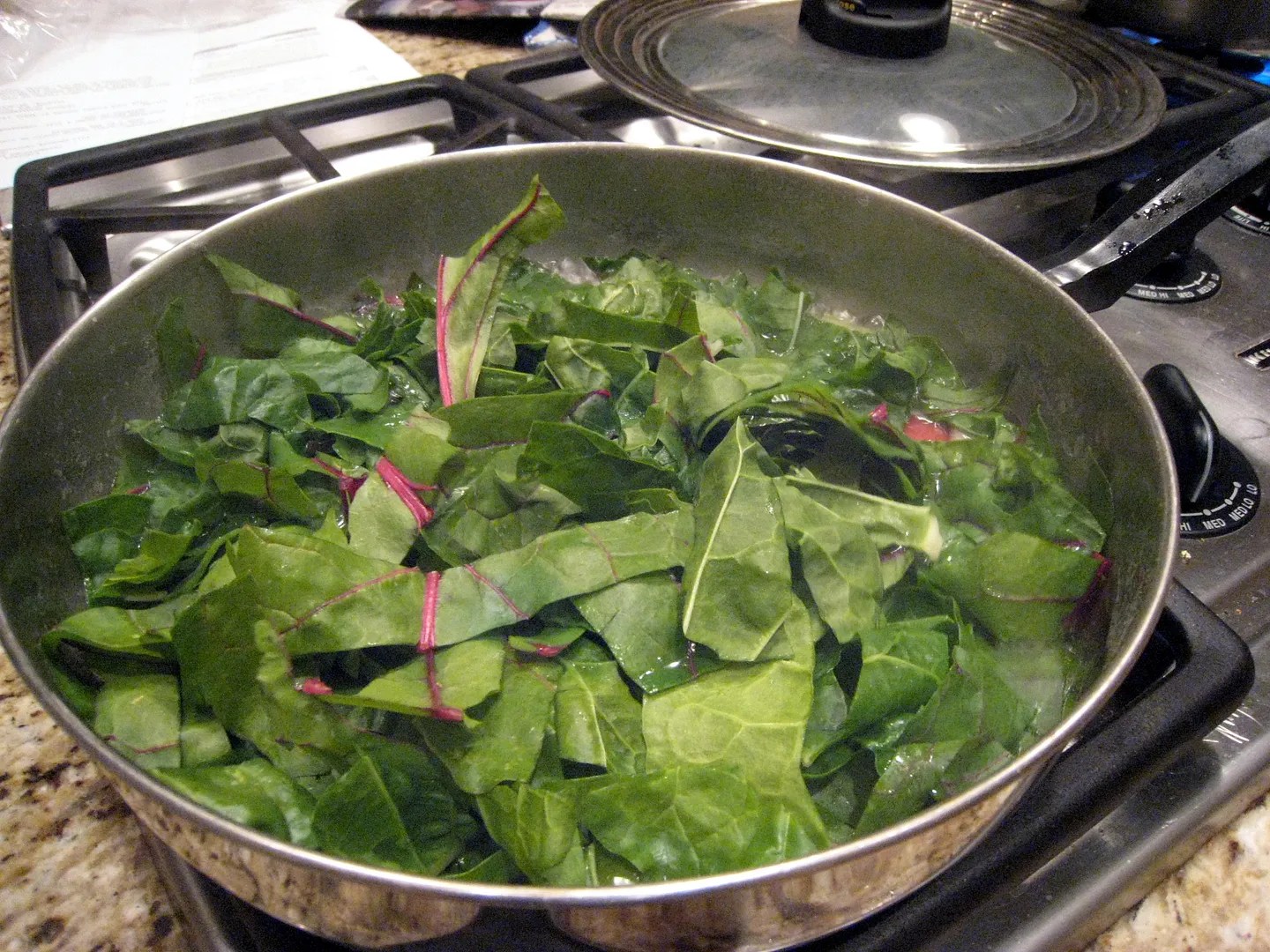
The finished product:

It reduced dramatically, about the same or more than spinach does; the serving above was probably 2/3 or 3/4 of the leaves shown in the top picture.
Was it good? Yes, actually it was delicious in all its salty aromatic glory. I’ll probably reduce the salt initially added to the water again though; it called for a tablespoon and I cheated back to about 1/2 of that and it was plenty for a healthy person, but probably still overkill for someone who needs to watch his salt intake.
The stems have a distinct flavor and shouldn’t be wasted; I have seen some warning that the red stems are too stringy to use but I have not found this to be the case.
This one will be added to the “approved” column for future use.
Back to normal
We had a function to attend for most of Saturday after the storms so I really didn’t get to inspect things closely until Sunday.
All in all, the garden came through pretty well. The short burst of small hail that preceded the strongest winds damaged some of the greens. While it looks like all will survive there are a lot of perforations in the leaves that took direct hits; there was no downside as these leaves all contributed to yet another a large dinner salad Sunday evening. The wind and/or hail snapped off a handful of asparagus stems a couple feet up as well; the affected ones were all near an edge of the bed.
Sunday was labor intensive in preparation for warm season plantings to go in this week. I still had plenty of storm debris to gather and stack in a back corner (for chipping into mulch/compost material when I have time). Additionally, the warmer days have been a constant reminder that bare ground brings weeds so newspaper/cardboard + chips/mulch were “installed” in more areas amongst the boxwoods & the new beds. Finally, the many rocks I uncovered in the boxwood project were gathered one at a time and stacked neatly for a future project.
While there are a dozen or so large ones yet to be gathered, I present the newly created rock piles:

Late in the afternoon when thoroughly worn out from the rock project, I wandered around with the camera as I wound down for the day:
New Zealand Spinach volunteers transplanted from another bed:

Baby blueberries on the stem:

Miniature Pak Choi (“joi choi”) developing nicely:

St Valery carrots that really really needed some thinning (and the photographer really really needed a snack):

And finally, some honeybees were diligently extracting pollen from the tiny asparagus blooms. It was difficult to get any sort of focus in the pictures due to the dispersed background of the asparagus; this one was the best of the bunch. Note the bright orange bundles of pollen on the bee’s back legs as he’s hanging upside down:

More perils of spring
Today’s storm loop, still nasty a couple hours after the tornado touched down about 1/2 mile from the house.

Once again, we fared better than the next block (homeowner was home and was not injured).
Masters Gardener
Over the past couple of years I have been patiently waiting for a Master Gardener class to become available through my local extension service office. The one that finally opened was scheduled to take up half a day each week; after careful consideration I instead decided it best to honor my responsibilities and commitments to my employer and customers and spend that time at work. So alas, there will be no newly broadened knowledge base, no new certifications, no glory in achievement.
As a consolation prize, I declared myself a Masters Gardener Monday evening before the storm. The bamboo flagpole was moved to a more prominent location and rigging hardware was added. Slowly the souvenir picked up this past weekend in Augusta was raised above the original plot of beds and allowed to flap in the strong winds preceding the storm.
The plants were unimpressed.
Family rolled their eyes.
Friends and neighbors pretended there was some normal and obvious reason that one should fly a golf flag on bamboo in his yard.
…

Seriously, some progress has been made (new plantings, new beds, new “cleanup landscaping”) that will be reported in the next day or two.
Escape II and Scapes I
A couple weeks back in the Escape post, I completely forgot the best volunteer escapee of the spring. Last spring I crew a late & crowded bed of Simpson lettuce in one of the alley beds. Apparently, as has recently become habit, I left some plants to go to seed as the season ended.
Two plants, twins maybe, sprouted among the chickweed immediately adjacent this (now) garlic & shallot bed and have taken root nicely in spite of my complete lack of attention to them. Mrs cohutt has cut a few small leaves off along the way and they still have done well.
The panorama of the bed of garlic with the Simpson twins in the front:

Closer, with my watch in the picture for scale:

I can’t grow lettuce this large and full when I try- I think nature is telling me something. Yeah, whatever….as a reward for their effort, I’m going to eat these for dinner later in the week.
But what about the scapes?
Last night after dusk but before dark:30, I thought I spotted a scape among the shallots in this same bed. This evening I investigated and sure enough, there were scapes emerging from several shallot plants in every bed.

One was a little out of control (?)

After a quick check I find that shallot scapes are common when shallots are set out in the fall (as these were). I also find a long list of recipes incorporating the scapes and a couple even for the flowers.
So I’ll let them fatten up a bit more and then start harvesting them for spicy additions to salads and future stir fry experiments.
In the meantime the tornado siren has started going off as this front is kicking us in the teeth so I’m gonna cut this one short. (Apologies for the lack of proofing. )

This spud’s for you
A couple of hours before “the” storm hit , I got most of this season’s attempt @ potatoes in the dirt.
Last year my attempt at growing them in straw wasn’t particularly productive. I believe this was due to a couple of reasons- First, I didn’t check out whether anyone had success in this climate growing the varieties I ordered. Maybe someone has but I’ve never seen any of them listed as ideal for Georgia. Second, I chose to put the tuber pieces on top of the soil and cover them with straw vs burying them under a little soil. Cricket nymphs had a field day on them and by the time I discovered this the damage was done. At this point I covered them up with dirt and then put the straw back on. Several still sprouted but the yields just plain stunk.
So this year I am starting over using recommended varieties for this climate and soil (Red Pontiac, Yukon Gold and Russet).
I built two fairly deep potato boxes out of shelving I salvaged from our renovation project and installed them behind the boxwoods in the back portion of the yard. In each went 5 large tuber pieces ( Red Pontiac and Yukon Gold).

A large part of one of the 16×2 beds will host spuds as well; 2 rows of tubers roughly 1 ft away in the sections between the lettuce and chard:

And finally, the western portion of the new 16×3′ bed next to the asparagus will include a long line of potato plants at the base of the “Christmas” pole limas. The dirt piled up on the left side of the bed will be hilled up around the plants as they come up. (The beans can wait a little while for the weather to warm up)

Speaking of the Asparagus bed, the plants are continuing to send up new growth, with much of it already taller than me. ( My “anti-flop retaining rope and string is visible.)


Chop shop
A boring report on the tree situation follows for those who are interested and have asked.
The trees didn’t do much damage to anything- they actually were suspended between the boxwood nubs by luck and a stout branch or two. The tops did bruise up some garlic planted nearby but it would appear all but one of the plants will be fine.
The nasty fat trunk-ed Cherry Laurel I have been cursing for years basically fell along the property line, crushing a flimsy welded wire fence but ending up hanging over the long line of American boxwoods I spent a few weeks moving to that border.

Closer up, it is apparent that most of what is over the box woods are the leafy top branches.

Thinned (last night):

Chopped (this evening)


I’ve got to put some thought into cutting up the trunk laying along the fence line, otherwise I’ll wipe out a row of transplanted boxwoods.
This is not a test
This is not a test.
The radar image on your screen indicates all planned spring garden activity will be shelved for a few days.

That was the radar of the storm crossing cohutt’s fence shortly after 9:00 last night.
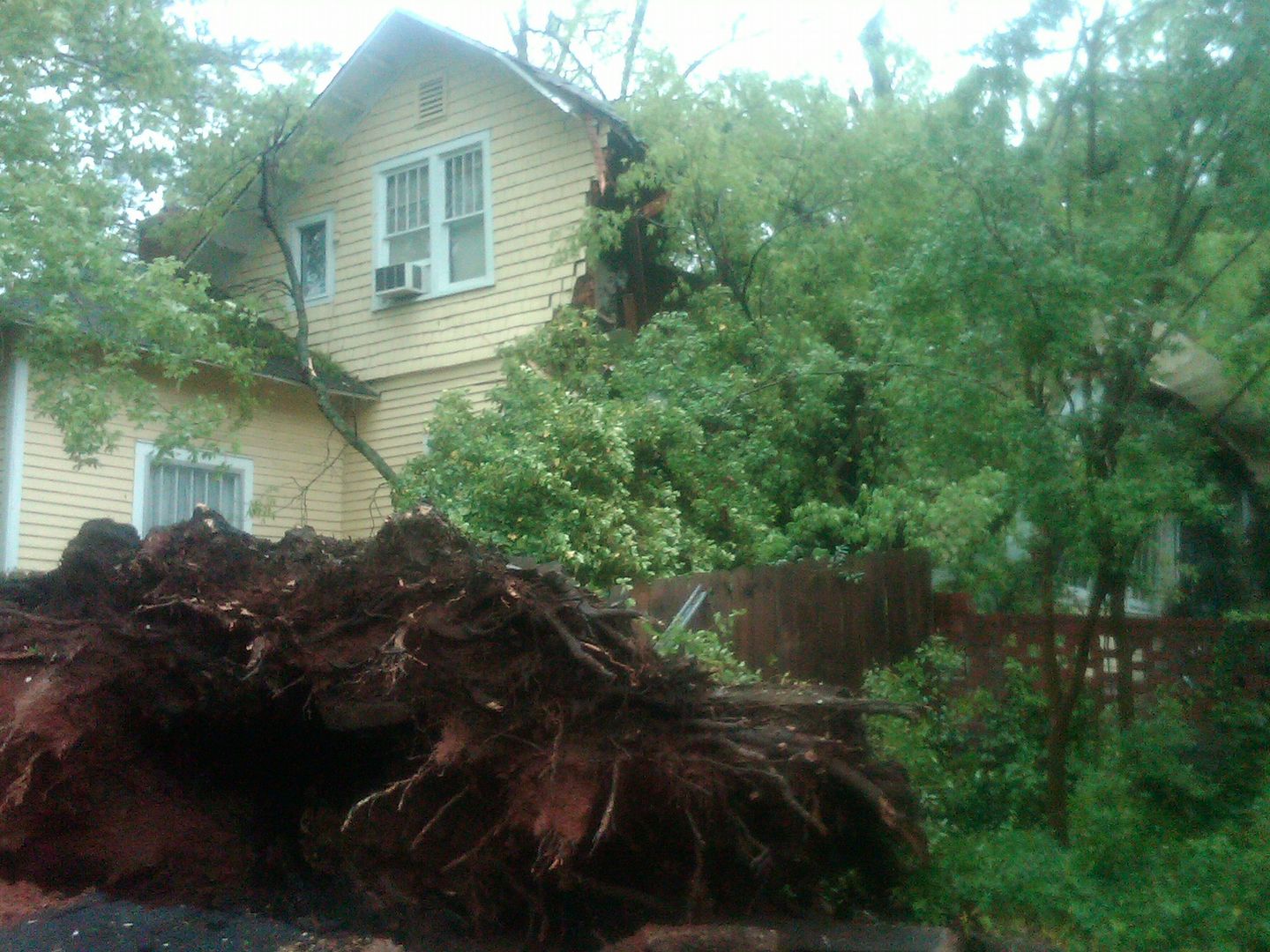
In the last few years, trees have crushed portions of houses 2 doors down, across the street and then last night 3 houses up the road from me. I’m thinking of moving to a barren, treeless wasteland someplace, at least until tornado season passes this year.
Fortunately the trees that fell into my backyard (my neighbor’s trees actually) did not damage anything important. Trees missing things is good but they still need to be cut up and removed.
Progress to follow.
Eventually, that is.
When there is some I mean….
Never mind.
A Fool’s April Allium Assessment
I’ve read that the Allium family includes a lot of pretty flowering bulbs. I’d post something insightful about some of these if I only knew anything about them, but I don’t.
So today’s post is going to cover the edible part of this family that wintered over in the yard here… garlic, shallots, & elephant garlic. I also have a hundred or so yellow onions in this year, but they have only been in for a few weeks and can’t compete photogenically just yet….
In a post last fall I mentioned that I liked the idea of something growing all winter with no maintenance that takes up relatively little space. Cloves of garlic sure look small going in but I can testify that once they have developed into two foot tall plants, the quarter square foot allocated to each doesn’t seem like much . Most of my garlic and shallots are spaced on a 6″ grid vs planted in rows; this is what Mel Bartholomew suggests in all his Square Foot Gardening books. I’ve read that spreading the spacing out a bit might increase the average size of each head of garlic but with less plants in the ground the overall yield in the season tends to be less.
First, just for perspective, picture below shows a head of garlic, a clove of elephant garrlic, and a single shallot bulb or “clove”.

The assesment begins…..
After reviewing things I have decided that I am going to have about the right amount of shallots, too much garlic (if that is really possible) and too little elephant garlic.
The two beds NOT behind cohutt’s fence (two earlier triangular beds along the alley adjacent to my house) seem to be doing well, especially now that I’ve freed them of competing chick weed and the like.
Bed #1 is a center grid of shallots surrounded with a border of softneck garlic. ( Last spring I stuffed this bed full of either Black Seeded Simpson or Simpson Elite lettuce. Obviously, I let some linger into the summer long enough to drop a seed or two. )

A few yards away at the back corner of the house is the second alley bed; this bed was catnip for the last 2 years and I’m sure I’ll be weeding catnip seedlings out soon enough. This bed is sheltered vs the cold due to the western orientation and the fence/brick nearby that hold/reflect the sun’s heat. Additionally, the furnace and dryer vents aren’t far off.
The left side is a hardneck garlic in its second generation in my garden; these plants’ “parents” grew from cloves I received in the fall of 2009 in a trade for a few 44 home cast bullets and were the subject of one of my first posts “Bullet Garlic“. The right side is another cluster of shallots.

The largest planting is mostly softneck garlic with a dozen or more shallots along one side. This bed was very fertile last year; it is on the site where I composted leaves for 20 years and it received the largest cloves out of my seed garlic. Judging by the diameter of most of the garlic stalks I’m hoping these turn out to be the huge heads I’ve seen harvested from other (internet) gardens.
Inside curve of the bed

Outside curve of the bed (shallots in the middle of this side- the big clump of green).

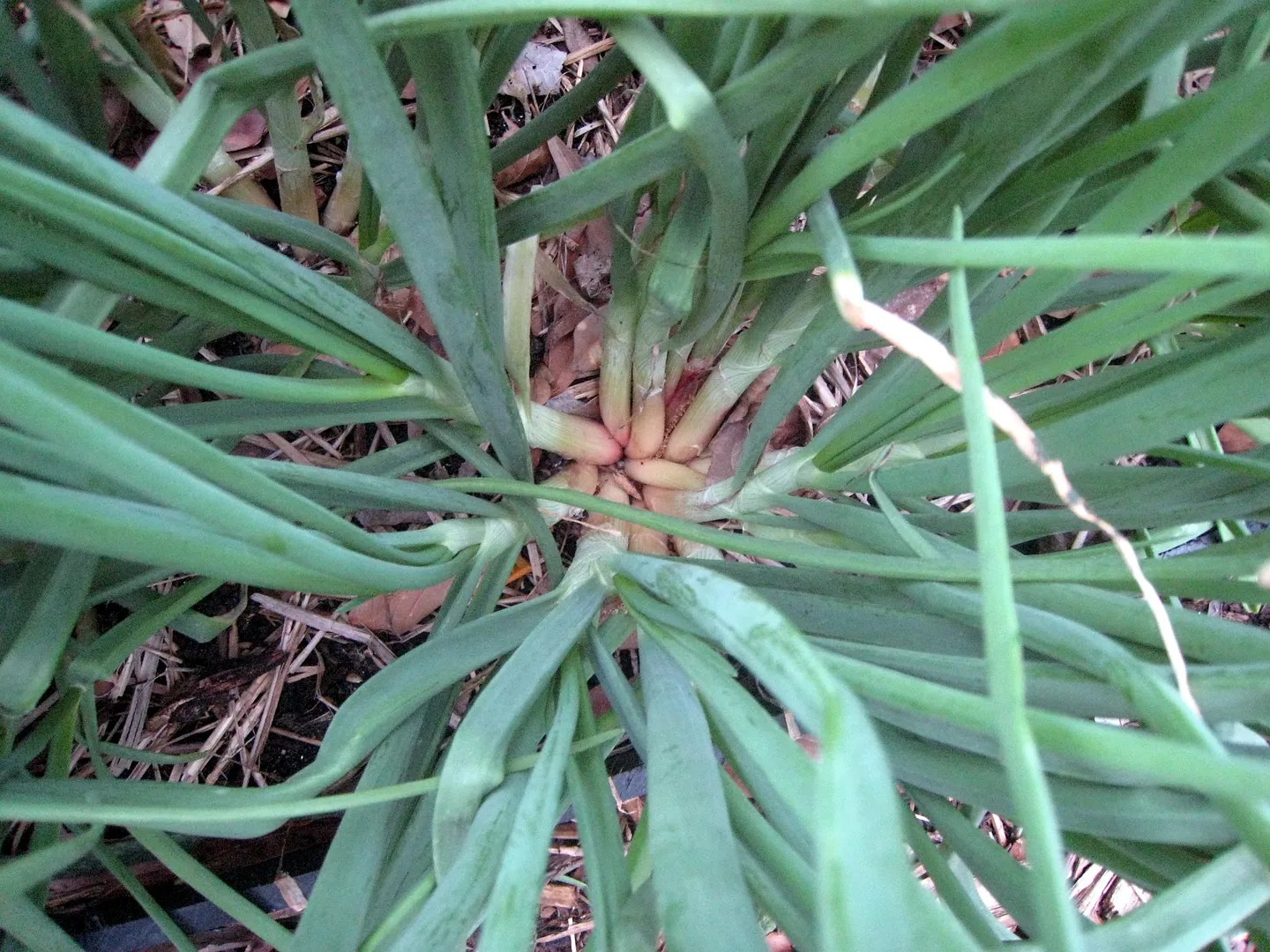
A single cove of garlic planted in the ground produces one stalk; the energy harvested from the sun by this stalk fuels the formation of the head of garlic all wrapped together below. A cluster of shallots likewise can be divided into what resemble cloves as well; once replanted, this single “clove” sends up multiple shoots vs the single garlic stalk. At the base of each shoot is a new large shallot “clove”. I read about this a year ago but it didn’t sink in really until I looked down from above the shallot bed. As the shallots grow underneath the bases of the shoots spread slowly apart:
There are 6 or 7 Elephant garlic plants among the beds; these stout plants are an attractive addition to any landscape imho. Most articles about elephant garlic include something along the lines of “it is actually actually a leek and is not a true garlic”. (So please consider this my elephant garlic disclaimer and don’t point out it is a leek. 😉 )

Another elephant garlic plant, adjacent to the carrot patch (behind in the double-decker bed) more shallots, some onions and the ever hardy oregano plant:

There are a dozen or so more “squares of garlic scattered about in the other beds; no bed is without at lease a little. I’ve read that garlic is a good companion planting for a lot of other plants I grow. If it repels pests of any sort I’ll be surprised but what do I have to lose trying?
I’m sure you’ll all agree that this was as exciting a garden blog post as exists anywhere on this morning.
No? You don’t agree? OK then, you won’t be getting a garlic braid from me this year. I think I’ll have enough for everyone else in north Georgia though…..;)

 Behind cohutt's fence